Friday, February 2, 2024

During the Battle of Kwajalein Atoll in the Pacific War, black smoke billowed from the Japanese position on Namur Island as a result of the American invasion. Many dead Japanese soldiers were scattered around the Japanese position. American soldiers performed autopsies on the corpses.

  During the Battle of Kwajalein Atoll in the Pacific War, black smoke billowed from the Japanese position on Namur Island as a result of the American invasion. Many dead Japanese soldiers were scattered around the Japanese position. American soldiers conducted autopsies on the corpses. Namur Island in Kwajalein Atoll was recaptured by American forces during the Battle of Kwajalein, which began on February 9, 1944. The Battle of Kwajalein was a battle that took place from January 30 to February 3, 1944, at the end of World War II, when American forces invaded Kwajalein Atoll, which was defended by Japanese forces.

 The U.S. Army's 24th Marine Regiment began landing on Namur Island around 9:00 a.m. on February 2, 1944. A small number of Japanese soldiers attempted to resist on Namulu Island by hiding behind palm tree logs. The U.S. forces overwhelmed and crushed them with flamethrowers and explosives, and by the next day, February 3, they were annihilated. 11:18 a.m. on February 3, the occupation of Namul Island was declared. On Namul Island, a small number of Japanese soldiers hid behind palm tree logs and attempted to resist the American troops, but they were successively crushed by flamethrowers and explosives and annihilated by February 3. The Japanese Imperial Headquarters announced the Gyokusai on February 25 with the total destruction of Kwajalein Island, Ruot Island, and Namur Island.

  On January 30, 1944, after massive air raids and naval bombardment, American forces totaling about 85,000 men approached the Marshall Islands; on February 1, the U.S. 7th Infantry (Army) Division landed on Kwajalein Island. The 4th Marine Division landed on the twin islands of Loi and Namur, about 72 km to the north. During the Japanese occupation, Loi Island to the west and Namul Island to the east were connected by a narrow land and causeway. Artillery bombardment had thoroughly destroyed the interior of Namulu Island, leaving it almost deserted and the palm forests burned to the ground; they captured Loi Island on February 1, and Namulu Island fell by noon on February 3. In the Battle of Kwajalein, the U.S. 7th Infantry Division declared Kwajalein Island safe on February 4. The Japanese were outnumbered by the Americans from the start and chose to fight to the last and be annihilated in a crushing defeat. Japanese casualties on the islands of Roi and Namur were over 3,500 dead and about 200 prisoners of war. The U.S. Marines suffered less than 200 dead and about 500 wounded. On Kwajalein Island, nearly 5,000 Japanese soldiers were killed in action and only a handful were captured.


Thursday, February 1, 2024

During the Battle of Motobu Peninsula in the Battle of Okinawa in the Pacific War, an American soldier shot dead a Japanese soldier with a .45-caliber pistol during a nighttime raid, and his bloody body lay on his back in the street.

  During the Battle of Motobu Peninsula in the Battle of Okinawa in the Pacific War, an American soldier shot dead a Japanese soldier with a .45-caliber pistol during a nighttime raid, and his bloody body lay on his back in the street. Behind him, American soldiers surrounded the body of another Japanese soldier and performed an autopsy.

 On April 7, 1945, the U.S. Army's 29th Marines invaded Motobu Peninsula, located in a deep bend jutting west from the main island of Okinawa. The interior of Motobu Peninsula rose on a series of rocky ridges and ravines of Yaedake, the highest point of which was nearly 452 m. Until April 11, Japanese mortars and machine guns opened fire from high ground, and from April 13, American forces formulated a plan of attack on the Yaedake positions under orders to destroy the remaining enemy forces in Motobu. on April 14, On April 14, the U.S. forces advanced eastward toward Yaedake and encountered Japanese machine gun and rifle fire.

 On April 15, the Marines entered the final attack position and attacked from the left (north) and east of the American positions west of Yaedake, over the ridge below the high ground. After a sharp exchange of fire, the U.S. Marines seized the ridge. by nightfall on April 15, the Americans had entrenched along the curved ridge facing Yaedake. by dawn on April 16, the 4th Marines, supported by planes, artillery and naval guns, invaded the steep slope of Yaedake. by late afternoon on April 16, U.S. By late afternoon of April 16, the U.S. forces had secured the summit and the Japanese defenders were either killed or scattered. On the other ridges of Yaedake, heavy mortar and artillery fire defended the American forces, and at 6:50 p.m. on April 16, the final Japanese assault came from outside the Kiyosuetai camp shelters, killing about 100 Japanese.

  During the Battle of Hombu Peninsula, they counted over 2,500 dead Japanese bodies and captured about 46 prisoners of war. American losses were 236 dead, 1,061 wounded, and 7 missing. Japanese resistance was greatest in northern Okinawa, near the Motobu Peninsula. The Marines drove the Japanese forces through Motobu Peninsula and isolated them near the ridge of Yaedake, where the Marines eliminated the Japanese by April 18.


Wednesday, January 31, 2024

GDR soldiers have uncovered several groups of human skeletons from a mass grave near Oranienburg, north of Berlin. They are believed to be victims of the NKVD between 1945 and 1950.

  Soldiers of the German Democratic Republic (East Germany, GDR) Army discovered several groups of human remains of prisoners in a mass grave near Oranienburg in the Sachsenhausen Special Camp, north of Berlin, which were discovered between 1945 and 1950 by the Soviet Union's secret intelligence agency, the NKVD (National Committee of the People's Commissariat of the Interior). They were believed to be victims of prisoners from the Sachsenhausen Special Camp. The camp housed senior Nazi officials, political prisoners, and inmates sentenced by Soviet military tribunals.

 The Sachsenhausen concentration camp was established by the SS in 1936 and received its first prisoners beginning in 1938; by the end of the war in 1945, approximately 11,000 Jews were held in the Sachsenhausen concentration camp. Liberated by the Soviet Army on April 22, 1945, the Nazi German concentration camp at Sachsenhausen was converted into a special camp for the Soviet military government from August 1945 to March 1950. The Nazi concentration camp near Oranienburg, Germany, was used from May 1936 until April 1945, just before the defeat of Nazi Germany. Senior Nazi officials were specially detained, as were political prisoners and inmates sentenced by Soviet military tribunals.

 As part of the Allied policy of de-Nazification, the Soviet military established ten special camps in Soviet-occupied territory after the military defeat of the National Socialist regime. Special Camp No. 7 in Sachsenhausen (No. 1 since 1948) housed about 60,000 inmates, the largest number among the special camps; between 1945 and 1950, about 12,000 people died of hunger and disease. During the famine winter of 1946-1947, the meager rations were cut, resulting in many deaths.

 After brutal interrogations and conditions in the temporary camps, most detainees found the buildings of the Sachsenhausen Special Camp provided better accommodations, but the barracks were overcrowded. Internees were crammed onto bare wooden planks. Ruinous sanitary conditions, lack of food, medicine, clothing, and heating fuel led to disease and epidemics. Mortality rates were high, reaching a high in 1947. Inmates were not allowed any contact with the outside world, and the special camps, also called silent camps, were not forced labor camps.

 Prisoners who died in the special camps were buried anonymously in mass graves, three of which were discovered and opened to the public after the fall of Berlin. In March 1950, a few months after the founding of the German Democratic Republic, the Soviet special camps were disbanded. Approximately 8,000 prisoners were released from the special camp at Sexenhausen, and a small number were taken to the Soviet Union. The last internees were more than 7,000 Soviet citizens and Russian immigrants, captured Soviet prisoners of war, former forced laborers, and Red Army soldiers who had committed crimes.


Tuesday, January 30, 2024

During the Battle of Tarawa in the Pacific War, the bodies of nearly 1,000 or more U.S. Marines and sailors fell among the waves, beaches, shell holes, and fallen palm trees on Betio Island.

   During the Battle of Tarawa in the Pacific War, the corpses of nearly 1,000 or more U.S. Marines and sailors lay among the waves, beaches, shell holes, and fallen palm trees on Betio Island. The bodies of American soldiers were scattered around Betio Island and washed by the waves of the Pacific Ocean. Nearly 4,700 members of the garrison, which included Japanese combat troops and Korean labor units, all but 17 prisoners of war were killed.

 From November 20 to November 25, 1943, in Operation Galvanic, U.S. Navy and Marine Corps units carried out an amphibious assault to occupy Tarawa Atoll. The landing sites were knocked out by U.S. forces. Japanese base wrecked at Tarawa Atoll," ran the headlines in American newspapers. Often accompanied by photographs of the battle sent from the front lines. An unusually high percentage of the photos, which made the battle look worse than it was, showed unfamiliar dead American soldiers. The death toll rose shockingly as American corpses littered the beaches in a short period of time. A list of war casualties was released to the media. Local Marines replaced the photos of the dead with portraits of those who had died in the line of duty for their country. The bloody Battle of Tarawa buried the small island of Betio with some 6,000 corpses.

 Betio Island in Tarawa Atoll was an island of about 1 square kilometer, a 1.21 km2 sand island only a few meters above sea level. It was dotted with forts and fortifications, the pinnacle of Japanese defense engineering. Sand-covered concrete blockhouses, palm tree shelters, anti-ship batteries, slit trenches, minefields, and seawall launching pads were scattered across Betio Island. U.S. casualties in Operation Galvanic were 997 Marines and 30 sailors killed, 88 Marines missing, and 2,233 Marines and 59 sailors wounded in action.

 Tarawa Atoll, located just a few degrees off the equator, saw temperatures reach triple digits during the battle, and the heat and humidity created conditions for corruption. Corpses that were only two days old had already turned a sickly green color. The air was filled with coral dust, the miasma of death, and a stench that was nauseating and horrifying. The small area of Betio Island was the scene of fierce fighting and constant attacks by the Japanese. It was essential to carry the large numbers of lying, decomposing and fast-disintegrating corpses underground, and there was no time to give the dead a proper burial.


Monday, January 29, 2024

After devastating concentrated fire by Soviet troops, the Seelow Hights were littered with the corpses of German soldiers. The remaining Wehrmacht units that had been deployed 70 km east of the Berlin suburbs to oppose the Soviet forces were overrun.

   The desperate German counterattack in the Seelow Heights led to several days of heavy fighting on key fronts. The Seelow Heights were littered with dead German soldiers after devastating concentrated fire by the Soviet forces. The remaining Wehrmacht units that had been deployed against the Soviet forces on the eastern outskirts of Berlin were overrun. Many German soldiers believed that if the Soviets would not surrender or accept prisoners of war, they would die anyway, so it was better to die fighting. Suspected deserters and losers were summarily executed by the SS.

 The Battle of the Seelow Heights, about 70 km east of the capital Berlin, was fought on the Eastern Front at the end of World War II, with fighting breaking out from April 16 to April 19, 1945. The battle saw Soviet forces invade and occupy the Zerow Heights, located east of Berlin. The Zerow Heights, known as the Gates of Berlin, were attacked by the Soviet Army's First Belarusian Front. The battle lasted three days and was extremely fierce as the Germans tried to defend their capital, Berlin. The German positions were finally crushed on April 19, opening the way to Berlin for the Soviet forces.

 At 3:00 a.m. on April 16, a massive bombardment of the German positions began. The Soviet troops suffered heavy casualties from the concentrated bombardment by the Germans on the swampy ground, and from the night of April 16, the Soviet artillery invaded. on the morning of April 17, a massive bombardment began, and the Soviet forces against the Zerow Highlands began a gradual advance against the German garrison. The Soviets launched another offensive on April 18 and began to break through the German lines with heavy casualties. By evening, the Soviets had reached the Germans' final line of defense. The Soviets began to bypass the Zerow Heights to the north, and the Soviet forces that surged forward on April 19 overwhelmed the Germans' last line of defense. The Germans were forced out of position and began to retreat westward toward Berlin. With the road to Berlin now open, the Soviet forces began a rapid advance toward Berlin.

 In the Battle of the Seelow Heights, the Soviet forces lost more than 30,000 men killed in action, while German casualties totaled about 12,000. With the defeat of the Germans, the last organized German defense between the Soviets and Berlin collapsed. Soviet forces besieged the German capital Berlin on April 23 and began the final battle of Berlin, which fell on May 2, ending World War II with the unconditional surrender of the Western Front on May 7 and the Eastern Front on May 9.


Saturday, January 27, 2024

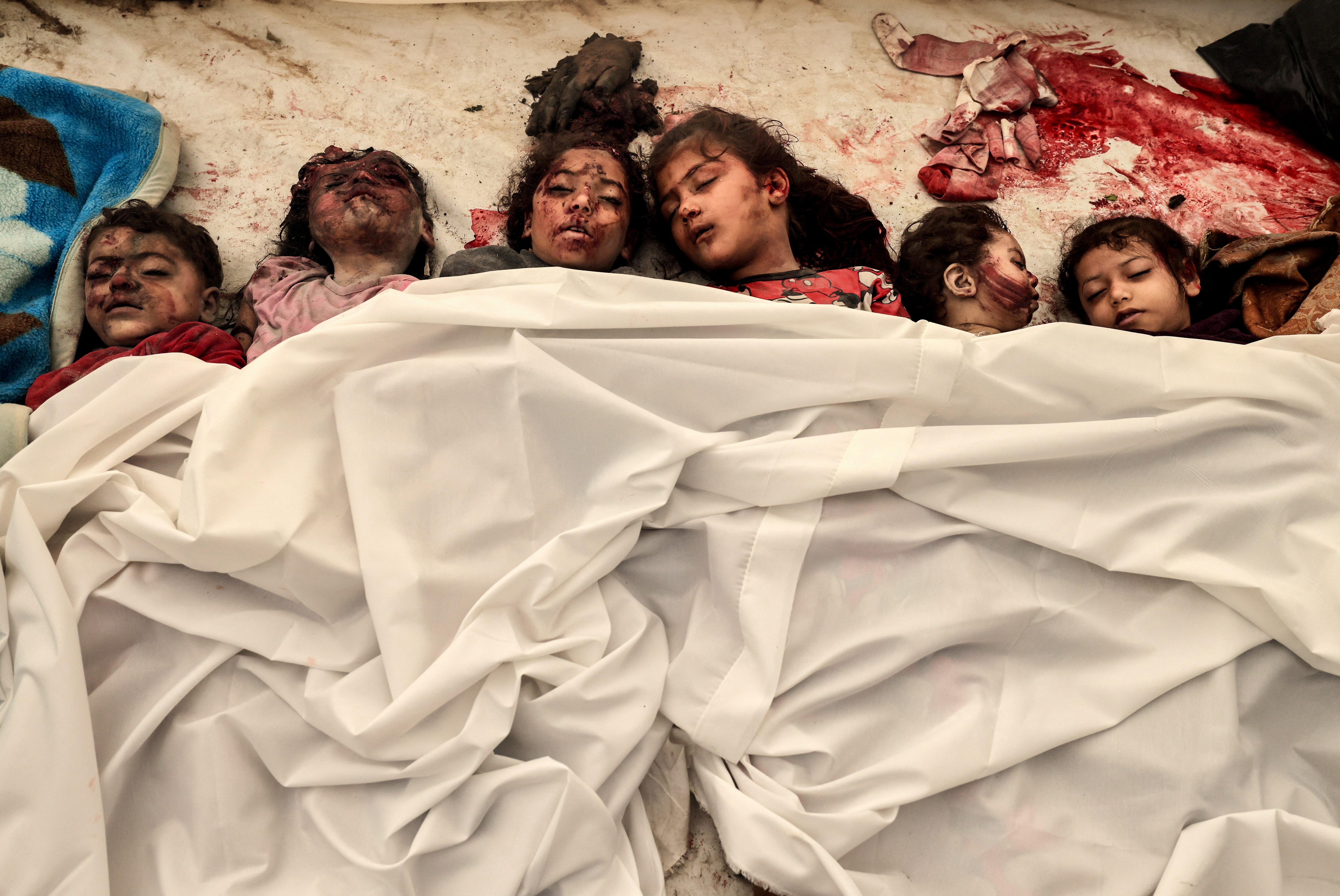
On October 22, 2023, the bodies of six children killed in an Israeli airstrike lie in the morgue of Al-Aqsa Hospital in Deir Bara, central Gaza Strip, amid ongoing fighting between Israel and the Palestinian Hamas armed group.

  The bodies of six children killed in an Israeli airstrike lie in the morgue of al-Aqsa Hospital in Deir Bara, central Gaza Strip, on October 22, 2023, amid ongoing fighting between Israel and the Palestinian Hamas armed group. The bodies of six children killed by Israeli airstrikes in the Gaza Strip lie in the morgue of Al Aqsa Hospital. According to colleagues at Al-Aqsa Hospital, the children were the children of two families living in the same house.

 In the 24 hours of November 28, 2023, rescuers collected 160 bodies from under rubble and from roads in the Gaza Strip, bringing the death toll since the start of the Israeli offensive on October 7 to more than 15,000, including more than 6,150 children and 4,000 women. Due to a lack of machinery and equipment to remove the debris, rescuers have so far exhumed the bodies by hand and using primitive methods. Approximately 6,500 missing persons are still under the rubble or unaccounted for.

 Since the temporary humanitarian ceasefire began on November 24, rescuers, first responders, and civilians have done everything they could to collect as many bodies as possible. The past five days have expressed the horror of the humanitarian catastrophe that has struck the Gaza Strip. As a result of Israeli air, land, and sea bombardment, some 300,000 homes were damaged, 50,000 of which were completely destroyed.

 Despite the cease-fire, occupation forces prevented civilians displaced to the southern Gaza Strip from returning to northern cities and towns. Israeli occupation forces stationed on Salah al-Din Street opened fire on civilians trying to head north to inspect their homes and search for missing family members, killing three and wounding others.

 On December 14, the Israeli army's shelling of the Gaza Strip killed some 18,787 people and wounded more than 50,897, mostly women and children, according to the Gaza Strip Health Ministry. Numerous victims still lie under rubble and on roads.


Warning: The bodies of children killed in an Israeli strike, lie on the floor at the morgue of the Al-Aqsa hospital in Deir Balah in the central Gaza Strip on October 22, 2023, as battles continue between Israel and the Palestinian Hamas group. (MAHMUD HAMS / AFP)


Friday, January 26, 2024

Kiyoshi Kikkawa, a 33-year-old man, was exposed to the atomic bomb in front of his home, about 1.5 km from the hypocenter, on August 6, 1945.

    The entire back of Kiyoshi Kikkawa, who still has keloidal burns from the heat of the Hiroshima atomic bomb, is photographed at Hiroshima Red Cross Hospital on April 30, 1947.Kiyoshi Kikkawa, a 33-year-old man, was exposed to the atomic bombing of Hiroshima City on August 6, 1945, in front of his home about 1.5 km away from the hypocenter. He was hospitalized at the Hiroshima Red Cross Hospital in February 1946 and underwent about 16 surgeries, including skin grafts, before being discharged in April 1951 while receiving public assistance. A photograph taken on April 30, 1947 was featured in Life magazine and other publications as "ATOMIC BOMB VICTIM NO. 1 KIKKAWA" (Atomic Bomb No. 1).

  The shoulder, arm, and back burned by the heat rays of the Hiroshima atomic bomb have raised flesh scars and keloids, and the surgical scars are fresh. Masaru Kuroishi (who died in 1990 at the age of 77), an X-ray technician at the Hiroshima Red Cross Hospital, took the photographs as a medical record before and after treatment under the direction of doctors. He began taking photographs of the pathological conditions of A-bombed patients at the Hiroshima Red Cross Hospital (now the Hiroshima Red Cross and Atomic Bomb Survivors Hospital) in October 1945, about two months after the atomic bombing by the U.S. military on August 6, 1945.

 Masaru Kuroishi's photography was also under the direction of Deputy Director Fumio Shigeto and his colleagues. He and his colleague Seiji Saito, a pathology technician, recorded the effects of the atomic bombing on the human body. Some patients at the hospital were so injured that they could not even be identified by gender. Fumio Shigeto, the director of the hospital, told me to take various photographs, but my conscience got the better of me and I couldn't do it." Despite his conflicted feelings, he took nearly 50 photographs as a medical record.

  In addition to the direct deaths of tens of thousands of people, the atomic bombings of Hiroshima and Nagasaki resulted in a series of horrific consequences that have long characterized the entire region. Within a year of the atomic bombings, many people died from radiation and burns, and in the years that followed, many Japanese died of cancer and birth defects due to the radiation released by the very bombs.


The shooting took place around noon on Sunday, September 5, 1971, at the Kreuzberg district border in the German Democratic Republic (formerly East Germany). Border guards pulled back a fugitive who had been shot to death after a failed escape attempt.

  The shooting took place around noon on Sunday, September 5, 1971, at the Kreuzberg district border in the German Democratic Republic (formerly East Germany). Border guards pulled back a fugitive who had been shot to death after a failed escape attempt. The insistence of the Socialist Unity Party of Germany (SED) state on unrestricted control of the East German population was most clearly and brutally demonstrated in the border system. Those who fled the country without the rare permission of the GDR authorities risked their health and lives.

  When the Berlin Wall was erected on August 13, 1961, the East German authorities separated the free West Berlin from the controlled areas by a wall. According to official figures, some 1,245 East German citizens had been shot dead while attempting to cross the border by 1989. Of those, about 136 had been killed trying to cross the Berlin Wall by 1989; by the time Erich Honecker said in 1989 that the Berlin Wall would still exist 50 or even 100 years later, at least 130 people had already been killed by border patrol gunfire. The first victim was a woman, Ida Siegmann, who, in the early morning hours of August 22, 1961, attempted to escape, jumped from the window of her fourth-floor apartment, fell to the sidewalk, and died on her way to Lazarus Hospital from serious injuries. More recently, 20-year-old Chris Geffroy was shot and killed in February 1989, nine months before the wall fell. He was the last victim of the German border wall, which fell on the night of November 9, 1989, opening the border between East and West Germany.

 Many people fled to the West through the East German barrier. The East German authorities took steps to strengthen the border. Watchtowers were erected every 10 meters along the wall. East German border patrol soldiers were given cameras and ordered to record, meter by meter, the areas where the border wall was to be built. The approximately 1,200 negatives that were taken were stored in the military archives in Potsdam and were accidentally discovered in a cardboard box. Soldiers on border patrol were severely punished for committing minor crimes. In October 1973, the East German government issued a shoot-to-kill order to the border guards handling defectors to West Germany. In the event of a successful escape and crossing the border into West Germany, border guards who failed to prevent border violations and desertion from the GDR were subject to disciplinary action.


Thursday, January 25, 2024

On the afternoon of May 1, 1945, the U.S. 1st Marine Division encountered fanatical Japanese resistance along the Awacha Pocket of the Battle of Okinawa. From caves and concreted mounds on the ridge, the Japanese opened fire, accompanied by intense and intense small arms fire. There were many casualties in the American forces in the Awacha Pocket, and they were carried to their positions on stretchers.

  During the Battle of Okinawa, on the afternoon of May 1, 1945, when the 5th Marines occupied the remaining positions, the Japanese occupied and consolidated their positions on the southern edge of Awacha (Awaacha). U.S. Army tanks passing through Awacha came under fire from the Japanese. The 1st Marine Division met resistance from fanatical Japanese troops along the Awacha Pocket it faced. From caves and concreted Okinawan mounds on the ridge, the Japanese opened fire, accompanied by intense and intense small arms fire. There were also many battle casualties in the Awacha Pocket of the U.S. forces, and they were carried to their positions on stretchers. I witnessed a horrific battlefield with a mass of corpses. The U.S. forces lost about 200 men for every 91 meters of Japanese positions they occupied.

 During the Battle of Okinawa, Awaicha, located almost in the center of the southern part of the main island of Okinawa, was the scene of fierce fighting. After the landing of the U.S. forces on the main island of Okinawa, the Japanese Army stoutly defended the Awaacha area against the U.S. Marines invading from the west and the U.S. Army's 77th Division invading from the north in early May 1945, in what was known as the Awacha Pocket.

 On May 2, 1945, the U.S. Marines invaded in heavy rain and captured the nearest high ground. Soon after, they were forced to retreat under heavy Japanese fire from adjacent strong points. During the night, U.S. Marines engaged the Japanese infiltration force in a white combat. on the morning of May 6, 1945, four battalions of U.S. artillery, two Army and two Marine, shelled the Awacha Pocket before the 5th U.S. Marines launched their morning attack. on May 10, 1945, the 5th U.S. Marines finally sealed off the Awacha Pocket. The battle, often fought at close range, came to an end on May 10, and the Japanese lost more than 1,000 dead.


 The 77th Regiment, 5th Marines, 1st Marine Division, U.S. Army, on the right (west side), encountered heavy resistance from the Japanese. The Japanese position immediately forward of the regiment was south of the town of Awacha and was organized into a fierce battleground known as the Awacha Pocket. The coordination of tanks and infantry, supported by American heavy artillery, was the only means of invasion. It was not until May 11 that the Awacha Pocket finally achieved encirclement.

  By May 11, the 24th U.S. Army Corps had eliminated many Japanese positions in preparation for the full-scale offensive that followed, and the week of May 3 to May 10 saw a general strengthening of the front from Oki on the east coast to the Asakawa River in the west. More than 20,000 casualties, including noncombatants, were suffered. American forces on the Shuri Line extended the front at Maeda, Kochi, and Awakawa, making the lines of communication more secure and gaining more favorable terrain for the 10th Army's attack scheduled for May 11.


Wednesday, January 24, 2024

Jews from the Lodz ghetto who resisted deportation on Ljubna Street in Lodz, Poland, were massacred in the streets without prior warning by Jewish and German police and the Gestapo.

  Jews from Lodz (Łódź) Ghetto who resisted deportation on Ljubna Street in Lodz, Poland, were massacred in the streets by Jewish and German police and the Gestapo. On Ljubna Street in Łódź Ghetto, the Jewish Ghetto police forcibly removed people from their apartments for deportation from September 5 to September 12, 1942; from September 7, the German police and Gestapo fired without prior warning and killed on the street whenever there was resistance; in the September deportations Approximately 15,681 people were deported, hundreds were shot for resistance, and 35 were hanged. From that moment on, the Lodz Ghetto became a forced labor camp.

 From September 5-12, 1942, more than 15,000 Polish-occupied Lodz ghettoes were sent to the extermination concentration camp at Chelmno nad Nerem. Only a small number of privileged children of the ghetto community escaped deportation.

 On February 8, 1940, the German authorities established a ghetto in Lodz, occupied Poland. Second in size only to the Warsaw Ghetto, the ghetto was separated from the rest of the city, fenced off, and guarded. During the four years that the Lodz Ghetto existed, over 200,000 people, including Jews, resided in the Lodz Ghetto. The ghetto existed until August 29, 1944. During that time, approximately 45,000 people died of starvation and disease. Others were killed in extermination concentration camps. It was estimated that only 5-7,000 survived until the end of the war.

 The greatest tragedy in the Lodz ghetto, the deportation of the "Wielka Spera" affected mainly children under the age of 10, the elderly over 65, the sick and the unemployed. The decision to deport was made by the Greater Nazi Reich Security Service in late August 1942; between September 5 and 12, 1942, the people of the Lodz ghetto community who had survived the war were scarred for life. Evacuations from hospitals and the central prison on September 1 and 2, days before the deportations, caused panic. People told each other their worst predictions, and many of the escapees were killed, as were officials who had opposed the order.

 On September 4, 1942, shortly before the tragic deportation, Council of Elders President Chaim Mordechai Lamkowski asked the Jews to give up their children and old people, saying, "The Germans are asking you to give up your children and old people. Give the children and the old people to me. Give the victims into my hands. No more victims," he said in a speech.On August 28, 1944, Rumkowski was beaten to death in the Auschwitz concentration camp by prisoners of the Lodz ghetto in revenge for the Holocaust.


 On September 5, 1942, a curfew was announced on the walls of the Lodz ghetto and a deportation committee was set up; until September 12, the Jewish ghetto police and special units took people in according to lists and sent them to the station. The actions of the Jewish ghetto police caused great anger among the ghetto population. The police efficiently took elderly people by force in nursing homes. They pulled babies from the breasts of resisting mothers. Healthy teeth were pulled from the jaws. Mothers and fathers did not want to give up their children, who were several years old and resisting. Blood flowed in the streets of Lodz Geto, in the houses, and in the rooms.


Monday, January 22, 2024

Twenty-two female telephone switchboard operators of the Fukui Post Office Telephone Division died in the line of duty on July 19, 1945, when they were killed in an air raid by the U.S. Army on Fukui. Twenty-two female telephone switchboard operators, aged between 16 and 47, and one 60-year-old man in general affairs, who guarded the switchboard to the end even after an air raid warning was issued, were killed.

 Twenty-two female telephone switchboard operators of the Fukui Post Office Telephone Division died in the line of duty on July 19, 1945, when they were killed in an air raid by the U.S. Army on Fukui. Twenty-two female telephone switchboard operators, aged between 16 and 47, and one 60-year-old man in general affairs, who protected the switchboard to the last minute even after an air raid warning was issued, were killed as victims. They died of asphyxiation from smoke inhalation. The Fukui Post Office telephone annex, located at 1 Chuo, Fukui City, was a reinforced concrete structure. Incendiary bombs from an overhead U.S. air raid on Fukui pierced the roof, and the fire spread throughout the building. Telephone operators on duty fled from the switchboard room to another room. Twenty-three people died, including 22 female telephone operators and a 60-year-old man on general duty, from smoke inhalation from a neighboring house that was also on fire.

 Fukui City was devastated by an air raid by 127 American B-29 bombers from 11:24 p.m. to 0:45 a.m. on July 19, 1945, in the final days of the Pacific War. During the intensive 81-minute raid, approximately 865 tons of incendiary bombs were dropped on a radius of 1.2 km around the northwest area of the ruins of Fukui Castle. The weather was fine, increasing the accuracy of the bombing, and the damage was extensive. The U.S. military assessed the rate of destruction in the urban area of Fukui City to be about 84.8%, which was the second highest rate of destruction after Toyama City and Numazu City in the bombing of local cities in Japan. In Fukui City, more than 20,000 houses were destroyed by fire, and approximately 85,603 welfare citizens were affected, with the death toll exceeding 1,576. Of the 6,527 seriously and slightly injured, 108 of them died later.

 The city of Fukui was burned to the ground by incendiary bombs, and those who took refuge in air-raid shelters were burned to a crisp by the heat of the fire. People who jumped into the moat of Fukui Castle and the Ashiba River in search of water died in a heap. Even in Fukui Prefecture, frequent air defense and light control drills around urban areas were completely ineffective against large-scale urban bombing. During the Sino-Japanese War, the Japanese military bombed Chongqing and other cities, indiscriminately inflicting damage on non-combatants as well.


On January 24, 1945, on the Eastern Front of World War II in Belarus, the Soviet Army's 10th Tank Corps invaded the German city of Mühlhausen in Operation Murawa Elbing. Along the road, the bodies of German soldiers and residents were scattered.

  On January 24, 1945, on the Eastern Front of World War II in Belarus, the Soviet Army's 10th Tank Corps invaded the German city of Mühlhausen (now the Polish city of Mlynari) in Operation Mlawa-Elbing. Along the road, the bodies of German soldiers and residents were scattered. The city of Mühlhausen was liberated from Nazi German control. Soviet troops reached a wide front south of the Oder River and Frankfurt am Oder in Söden on January 31, less than 80 kilometers from the Soviet positions to the capital Berlin.

   In August 1944, the Germans had no difficulty holding off the Soviets on the Viswa front. In January 1945, the Soviet Red Army went on the offensive again, assembling powerful mechanized units and large artillery and air units. From January 12 to February 3 in Operation Viswa-Odel, the Soviet forces went on the offensive, invading until on the first day of February they reached the Oder Line, some 80 kilometers from the capital Berlin. The Soviet forces made a very rapid winter invasion: in Operation Viswa-Oder from January 12 to February 3, the Soviet forces lost approximately 43,476 dead or missing and 150,000 wounded, while the German forces lost approximately 300,000 more dead, wounded, and prisoners of war. In the months that followed, Soviet forces engaged in combat to collapse isolated German groups in East Prussia and Pomerania just prior to launching the final offensive against the capital, Berlin. After the initial collapse and heavy losses, the Germans organized a defensive position on the Oder River defending Berlin, the capital of the German Empire, to prolong the resistance of the besieged German forces.

 The final stages of World War II became increasingly disastrous, and the Germans began their retreat at great cost. Soviet forces invaded East Prussian territory, and on January 23, 1945, transports of refugees, soldiers, and wounded began to leave the ports of East Prussia and the Bay of Danzig. By the end of the war, some 2 million people had been displaced, and about 14,000 refugees died during the sea transport.On March 4, 1945, Russian troops occupied Czernin. Many residents fled. On the outskirts of the village, a camp was built by the Russians to house prisoners of war, who were later deported to Russia. Rape, abuse, murder, and looting occurred everywhere. Under a simultaneous bombardment by a group of Soviet tanks and machine guns, Kolberg was surrounded on March 4 and fell on March 18.


Sunday, January 21, 2024

Residents grieve as they stand near the bodies of residents killed in a massive Russian airstrike in Zaporizhia, Ukraine, on December 19, 2023.

  Residents grieve as they stand near the bodies of residents killed in a massive Russian airstrike in Zaporizhia, Ukraine, on December 19, 2023. In a new report on January 16, 2024, the United Nations announced that missile and drone strikes conducted by Russian forces across Ukraine in recent weeks had led to a sharp increase in civilian casualties in December 2023, killing about 100 more and wounding nearly 500 more.

 Russian military forces have reported a sharp rise in civilian casualties in December 2023 as a result of heavy missile and drone strikes across Ukraine, killing more than 100 people and injuring nearly 500, the United Nations reported. The UN Human Rights Watch for Ukraine reported that civilian casualties were 26.5% higher than in November 2023. According to the UN observers, the highest number of casualties occurred during Russian military attacks between December 29, 2023 and January 2, 2024, when winter temperatures plummeted; on January 4, 2024, Russian rockets hit the frontline town of Pokrovsk and the nearby village of Rovne, killing six adults and five children Two families of two were buried under rubble, with some bodies yet to be found; in another attack on January 6, 2024, in Novomoskovsk, a Russian missile strike exploded, injuring 31 civilians, including eight passengers on a minibus dropped during the morning commute, the UN said.

 The UN observers reported that 86 civilians were killed and 416 injured by intense missile and drone attacks by Russian forces that began hitting populated areas across Ukraine on December 29, 2023, and continued until early January 2024. The number of civilian casualties increased by 26.5% over November 2023, according to the UN observers, worsening from 468 in November to 592 in December. The UN observers reported that civilian casualties declined steadily in 2023, but a wave of Russian military attacks in late December and early January interrupted the downward trend.

 The UN observers reported that 86 civilians were killed and 416 wounded by intense missile and drone attacks by Russian forces that began striking populated areas throughout Ukraine on December 29, 2023, and continued until early January 2024. Since the Russian invasion of Ukraine that broke out on February 24, 2022, the UN Humanitarian Office has confirmed to the UN Security Council more than 10,200 civilian deaths, including 575 children, and more than 19,300 injuries. Neither the Russian nor Ukrainian authorities provided data on military losses, and the war dragged on for nearly two years without any sign of peace talks to end the conflict. Both Russian and Ukrainian forces have struggled to increase casualties on the other side.


Warning: People react standing near the body of a resident, killed in Russia's massive air attack in Zaporizhzhia, Ukraine, Friday, December 29, 2023. (AP photo/Andriy Andriyenko)

Saturday, January 20, 2024

In early October 1945, he was admitted to Hiroshima Army Hospital No. 1. Due to acute symptoms of radiation damage caused by exposure to the atomic bomb, most of the hair on his head had been lost from the front, sides, and back of his head.

   Japanese Army soldiers exposed to the atomic bomb were interned at the camp for the injured of the Army Ship Training Department, located in Ujina, about 4 km south-southeast of the hypocenter of the Hiroshima atomic bomb, and in early October 1945, they were admitted to Hiroshima Army Hospital No. 1. Due to acute symptoms of radiation damage caused by exposure to the atomic bomb, most of the hair on their heads had been lost from the front, sides, and back of the head. The main symptoms of the third to fifth week of acute damage to the human body were hair loss, hemorrhage including purpura, and lower hemorrhage, causing death with general weakness.

 Ujina, Hiroshima, was a port area, more than 3 km from the hypocenter, and suffered relatively little damage from the atomic bomb. The people who had been exposed to the atomic bomb in Hiroshima rushed to this area, which had survived the fire. One of the facilities that provided aid to the injured in Ujina was the Army Ship Training Depot. The Army Ship Training Department was an organization that provided education and training in ship operation to army units, and was stationed in the confiscated Daiwa Spinners Hiroshima factory. Since the number of troops receiving training was constantly changing, the barracks were not always full. There was also a stockpile of food, so there was no shortage of meals for about 1,000 people. At 8:15 a.m. on August 6, an atomic bomb was dropped on Hiroshima, and although the building was slightly damaged by the explosion, it was not seriously damaged. About an hour later, the injured began to arrive. By 3:00 p.m. on August 6, several hundred A-bomb survivors had been admitted to the hospital. The Army Ship Training Department became what should be called a field camp. Many of the inmates were seriously ill with A-bomb disease, and from August 10 to mid-September, approximately 3,000 people died.

 The Army Ship Training Center, which had been a field camp, was reorganized by order of the Ship Command and became the Army Ship Training Center Temporary Field Hospital on August 12, and with the defeat of Japan on August 15, the military wartime system was liberated. On August 25, the nameplate of Hiroshima First Army Hospital Ujina Branch was hung. During this period, the Army Ministry Investigation Team entered the area on August 8, and the 2nd Investigation Team on August 14. Using the Ship Training Department as a base, they were engaged in the investigation of the atomic bombing.


Friday, January 19, 2024

During the Battle of Tarawa in the Pacific War, U.S. Marines burst a flamethrower at Japanese soldiers who had ventured inland. The bodies of the Japanese soldiers were instantly engulfed in flames, and the bodies of the burned to death Japanese soldiers were scattered on the sandy beach.

   At the Battle of Tarawa in the Pacific War, the U.S. Marines were the first to deploy flame-throwing tanks. The flamethrower exploded at a Japanese soldier as he darted inland. The Japanese soldiers' bodies were instantly engulfed in flames. The bodies of Japanese soldiers burned to death by the flamethrowers during the Battle of Tarawa were scattered on the sandy beach. On the desolate island, the corpses lay on the beach covered in scorched earth and blood, and the air was filled with coral dust and the stench of death.

 On November 20, 1943, some 35,000 American troops launched an amphibious assault on Betio Island and Makin Atoll in Tarawa Atoll. The Makin Atoll was weakly defended and casualties were low. The fortified and intensive defense of Betio Island was accompanied by 76 hours of disastrous casualties, dubbed the Battle of Tarawa, and on the morning of November 20, following naval bombardment, the U.S. Marines approached the north shore of Betio Island in transport boats. Encountering low tide, they abandoned their landing craft on the reefs surrounding Betio Island. They were forced to walk to the beach under heavy fire from the Japanese. Once on the beach, they struggled to establish a safe landing base beyond the breakwater, and by November 20 they had secured the westernmost tip of Betio Island and the center of the northern shore.

 On November 21, American forces pushed onto the airstrip in the center of Betio Island. The largest securement was achieved on the western shore, and on November 22 the Marines borrowed two Sherman tanks and began an eastward advance. A nest of Japanese machine guns impeded the advance. Continued U.S. incursions from the north and west pushed the remaining Japanese defenders into a small area east of the central airstrip; on the night of November 22, the Japanese rallied for a banzai-style counterattack against the Marines, but the American lines held.

 In the early morning hours of November 23, the Japanese executed their second, third, and fourth banzai assaults. The Marines again pushed the Japanese back. The Japanese banzai assaults were the last organized effort of the Japanese forces. The only remaining Japanese resistance on Betio Island was a small position to the east. The Marines, supported by tanks, aircraft, artillery, and bulldozers, methodically destroyed the Japanese defensive positions. By early afternoon, the Americans had reached the eastern tip of Betio Island and declared it safe. Isolated groups of Japanese troops continued to appear in the weeks following the battle; with the exception of 147 prisoners of war (most of them Korean laborers), the Japanese garrison was wiped out and crippled. The U.S. forces suffered approximately 1,113 killed or missing in action and 2,296 wounded in action.

 Tarawa Atoll, a ring of coral reefs within the Gilbert Islands, an area consisting of many small islands in the southwest Pacific, was fortified in 1943 by about 5,000 Japanese troops who had built a strong fortification on the three-mile-long, 1,000-yard-wide atoll. Betio Island, the largest island in Tarawa Atoll, was home to a Japanese airstrip and was also garrisoned by most of the Japanese forces in the Gilbert Islands; by November 1943, more than 2,500 Japanese soldiers, about 1,000 Japanese construction workers, and 1,200 Korean forced laborers had defended Betio Island. Defensive bunkers and trench nets were placed inside Betio Island.


From April 29 to December 24, 1945, as Nazis—and nothing other than Nazis—Austrians were forced to exhume corpses.

The Soviet Union acted in its own self-interest. At times it took an extremely hard line against the Nazis, while at other times it behaved ...