Friday, October 6, 2023

In the Russian Civil War following the Russian Revolution, a White Army execution squad shot two Bolshevik suspects and hanged two more in 1920. Outside Petrograd, the White Army's Okhrana Field Division executed a captured Soviet suspect.

  In the Russian Civil War following the Russian Revolution, a White Army execution squad shot two Bolshevik suspects and hanged two more in 1920. Outside Petrograd, the White Army's Okhrana Field Division executed a captured Soviet suspect.

 In areas where violence became commonplace and Bolshevikized peasants and workers took control, landowners and employers were robbed, tortured, and murdered. In areas where the White Army held the upper hand, police and soldiers found Bolshevik suspects and where they suspected them, they slaughtered them in cold blood. White Army execution squads shot and killed two Bolshevik suspects and hanged another two. The Russian Revolution, which began as a bloodless overthrow of tsarism, now claimed millions of civilian victims. There was hardly a region of vast Russia where the populace was not separated into Reds and Whites.

 During the years that Russia was torn by civil war, atrocities and violence by both the Red and White armies reached their zenith. Both the Reds and Whites terrorized everywhere, shooting and hanging large numbers of civilians. If the bourgeoisie does not want to exterminate us, now is the time to exterminate the bourgeoisie" (August 31, 1918), wrote the Pravda newspaper. The Pravda newspaper stated, "The rotten bourgeoisie must be wiped out mercilessly from our city. All these people must be registered, and those among them who pose a threat to the revolutionary class must be eliminated. Henceforth the anthem of the working class will be a song of hatred and revenge!" (p. 3). Under these circumstances, the losers had no choice but to surrender or flee, hoping for the mercy of the merciless victors.

 The Russian Civil War was fought primarily between the Red Army (on the side of the Communists and October Revolution) and the White Army (on the side of the Russian Right, Republicans, Monarchists, Conservatives, and Liberals).The two major combatants were the Red Army of the Bolshevik-led socialist state led by Vladimir Lenin and the White Army, which was an ally of the Russian military, the Bolsheviks opposed their domination.


Thursday, October 5, 2023

Australian anti-tank guns succeed in temporarily checking the Japanese advance down the Malayan peninsula in January 1942. Tanks halted by felled trees have been reduced to smouldering wrecks. A dead Japanese soldier lies in the foreground.

    Shortly after the outbreak of the Pacific War in World War II, on January 18, 1942 in the Greater East Asia War, Austrian anti-tank guns temporarily halted the advance of Japanese forces southward across the Malay Peninsula. Nine Japanese tanks were badly damaged by Australian anti-tank guns in front of Bakri. Near Bakri in the Muar area, Japanese tanks, blocked by fallen trees, were reduced to burning wreckage. In front of it lay the bodies of two Japanese soldiers killed by an Austrian anti-tank gun.

 After the Japanese attack on Pearl Harbor on December 8, 1941, Japanese forces moved southward through Malaya, culminating in the occupation of Singapore in February 1941, and the Australian 8th Division, which was assigned to Malaya at the end of 1941, was already tragically lost, with most of its men taken prisoner by the Japanese. Singapore had been a cornerstone of Australia's security during the Greater East Asia War, but that cornerstone was shattered with the fall of Singapore to the Japanese.

 The Battle of Muar, the last major battle of the Malay campaign during World War II, took place from January 14-22, 1942, on the Muar River and around the Gemensah Bridge. Allied soldiers inflicted heavy casualties on the Japanese in an ambush at the Gemensa Bridge and in a second battle that took place several kilometers north of the town of Gemas. The Austrian 8th Division killed about 600 members of the Japanese 5th Division in the ambush at the bridge. In the battle north of Gemas, Austrian anti-tank guns destroyed several Japanese tanks. In this battle, the Japanese suffered the heaviest losses of the Malay campaign.

 The ambush attack was a success for the Allied forces, but the defense of Muar and Bakri on the west coast was a complete failure. The 45th Indian Infantry Brigade was almost completely wiped out, and two Australian infantry battalions suffered heavy casualties. Allied casualties reached about 3,100, while the Japanese lost about 700 killed in action and 800 wounded. In the Malaya campaign and the Battle of Singapore, more than 1,800 Australian soldiers were killed in action and about 1,400 were wounded. Approximately 15,000 Australian soldiers were taken prisoner of war at the fall of Singapore.


Wednesday, October 4, 2023

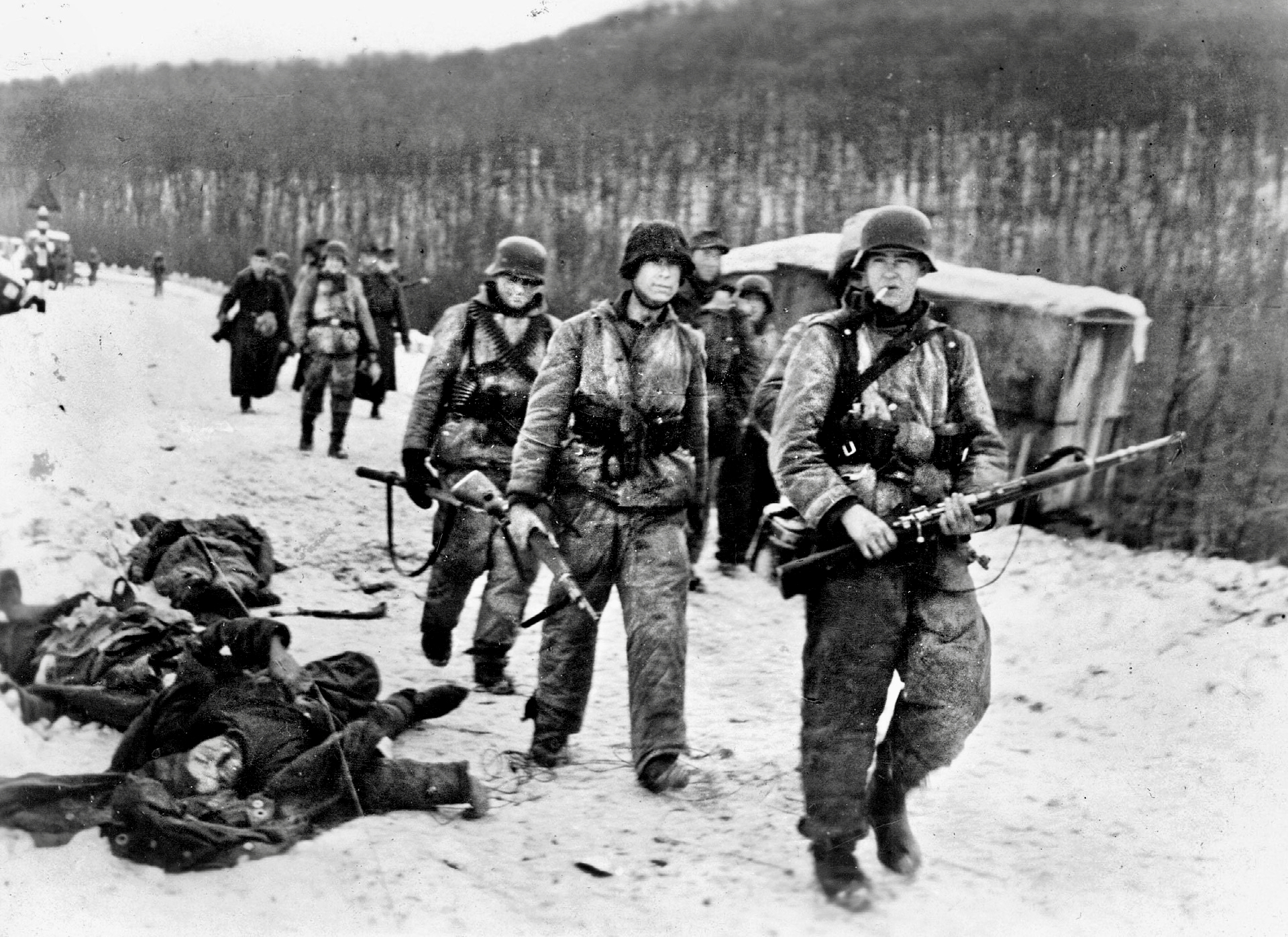
German armed SS soldiers invade the Hungarian capital of Budapest in a siege operation on January 23, 1945, with the body of a slain Soviet soldier lying on the edge of a snow-covered road on the way.

  Starting on January 18, 1945, German and Hungarian troops began the siege of Konrad III (Operation Konrad III), the lifting of the Soviet blockade of the Hungarian capital Budapest, until January 27. German Armed SS (Waffen-SS) soldiers invade the Hungarian capital Budapest in Operation Siege on January 23, 1945, as the bodies of slain Soviet soldiers lie on the edge of a snow-covered road on the way.

 On January 18, the first day of the offensive, the 4th SS Panzer Corps broke through the defensive positions of the Soviet 4th Guards and invaded deep into the defensive positions; on January 19, it broke through the continuity of the Soviet defensive line by sweeping through retreating Soviet troops and reached the Danube River near the village of Dunapentere; on January 20, the reserve force of Soviet forces, which were few in number, created a threatening situation on the 3rd Ukrainian Front.

 On January 21, the 5th SS Panzer Division defeated the Soviet 18th Panzer Corps and continued its northward advance. The Germans reached the floodplain of the Vary River 28 km southwest of the outskirts of Budapest, and after a long and bloody urban battle on January 22, the German 1st Panzer Division completely occupied Sturweisenburg. Soviet troops counterattacked the German 5th SS Division and 3rd SS Division. Between the villages of Adun and Ivancha, the 5th SS Division hit a large minefield. A German reinforcement reconnaissance battalion reached the Vary River, but the 5th SS Division was unable to approach the river due to heavy artillery fire by the Soviet artillery.

 On January 23, the 5th SS Viking-Panzer Division came under fire from Soviet anti-tank guns stationed on high ground on the northeast bank of the Valli River. They pursued the retreating Soviet units, which were repulsed in an attack near St. Peter's. They broke through both sides of the narrow-gauge railroad line and reached the other side of the Valais River. The 3rd SS Division was caught in the fighting of the onslaught by the Soviets.

 On January 24, the 5th SS Panzer Division and the 3rd SS Panzer Division launched a massive tank attack on Soviet positions behind the Valais. A 20-km wide section of the front broke through Soviet defenses; on January 26, the 4th SS Panzer Corps approached the Budapest cauldron at a distance of 25 km. The German tank groups that had advanced as far as the Danube River were cut off from their supply lines by the Soviet divisions, making them extremely vulnerable.

 On January 26, the Soviet 104th Rifle Corps and 23rd Tank Corps crossed the Danube River from the east bank and attacked the German groups from the north; on January 27, the German groups between Balaton and the Danube River had approximately 250 battle-ready tanks and assault guns remaining. A major Soviet counteroffensive began with a concentration of about 500 Soviet tanks and SAUs. In the south, in the sector of the front between Chalviz and the Danube River, the Soviets launched an offensive on the positions of the German 3rd Panzer Division. In the north, the Soviet 23rd Panzer Corps launched an assault on the Vali River with more than 100 tanks. The 5th SS Tank Division blocked the advance of the Soviet tanks for some time, and the Soviet troops also suffered heavy losses.

 On the night of January 28, 1945, orders were given to give up Operation Konrad III and prepare for an offensive at Dunafeldvar in southern Hungary; on January 28, the 4th SS Panzer Corps began a withdrawal to its original positions, retreating to the Bakonian Forest north of Lake Balaton, which it captured in Operation Konrad III All territory except Sturweissenburg was abandoned.

 Operation Konrad all but failed, and in the month-long fierce fighting in January, the 5th SS Panzer Division and the 3rd SS Panzer Division lost nearly 8,000 men, including more than 200 officers. The fighting in Budapest ended on February 13, 1945, with the surrender of the German-Hungarian Allied remnants.


Tuesday, October 3, 2023

After the fierce battle near Jiangqiao on November 18, 1931, the Japanese forces suffered casualties due to the massive bombardment of the Chinese troops. Japanese soldiers posted the war casualties on stretchers and transported them to their rear positions.

   On September 18, 1931, the Kwantung Army blew up the tracks of the South Manchuria Railway at Liujiaohu, a suburb of Mukden (now Shenyang) in the Republic of China, leading to the occupation of all of Manchuria (northeastern China) by the Kwantung Army on February 18, 1932. casualties. Japanese soldiers carried the casualties on stretchers to their rear positions.

  Beginning on the morning of November 18, 1931, the Japanese launched a general attack against the Chinese troops on the Sanmangbong. The Japanese bombarded the front line of the position for one hour, and the Chinese responded with artillery. At 8:00 a.m., the Japanese forces broke through the center, encircled the area, and launched a general attack. 10:00 a.m., the Chinese forces were unable to hold their position and retreated to the area of Ankang Creek. The Japanese added about 12 fighter planes, 12 tanks, and more than 30 pieces of artillery, and destroyed all trenches with heavy bombardment. The Chinese troops continued to fight and kill each other for a whole day and night, hungry, without rice or water, and shouting, until all brigades, half of them killed or wounded, retreated to Ankang Creek. The Chinese troops fought for three days, suffering more than 3,000 casualties, with about 2,000 more killed.

  During the Battle of the Three Watchtowers, the Chinese army requested reinforcements from all sides. None were directed from Beijing. Since the battle of Daoan Road, all the bullets were old stock from Heilongjiang Province, wet with mold and unusable. In one day and night of intense fighting, the Chinese soldiers had used up nine-tenths of their ammunition and could not fight a war unarmed. With many casualties, exhausted of ammunition and food, and no hope of survival, Ma Yushan ordered the Chinese troops to retreat. The Japanese army followed the Chinese troops from Hongqingzi. Ma ordered the provincial capital to be moved to Keshan and held Lunsha with about 500 guards and 700 cavalrymen.

  On the morning of November 19, the main Japanese forces occupied Yushu-tun, about 24 km from the provincial capital, and bombarded it with heavy artillery fire. About 5,000 or more Japanese soldiers invaded and occupied Qiqihar. Ma Chuangshan withdrew his troops from the Qiqi Road to Keshan, Baquan, and Hailun, thus ending the Battle of Jiangqiao. The Japanese forces suffered approximately 31 casualties, 104 battle casualties, 13 missing in action, and 300 frostbite victims during the Battle of Jiangqiao from November 4 to November 19. Chinese military losses were unspecified, but were estimated to be between 1,000 and 3,000. Ma Chuangshan arrived at Hailun on the evening of November 21. It was divided into positions at Wangyu, Hailun, Keshan, and Nulhe.


Monday, October 2, 2023

To incinerate the corpses of Ukrainians starved to death by starvation caused by the Holodomor, every evening around 1932, carriers dragged carts full of corpses to the mass graves.

  Every evening around 1932 carriers dragged carts full of corpses to mass graves for incineration of corpses of Ukrainians starved to death by starvation caused by the Holodomor. Ukraine was the site of the Soviet Holodomor (Ukrainian: голодомор), a famine-induced massacre that broke out in the territory of the Ukrainian Socialist Soviet Republic in 1932-1933, when the Soviets killed thousands of Ukrainians in the Holodomor (Ukrainian: голодомор). It was one of the worst national massacres in the modern history of Ukraine. The death toll ranged from about 2.5 to 7.5 million people. Joseph Stalin deliberately starved Soviet Ukraine. It marked the beginning of an era of genocide in Europe, with the Soviet army's ruthless requisitioning and looting of all the wheat.

  The Soviet Bolsheviks took control of Ukraine in 1919. In the years that followed, power passed from Lenin to Stalin's dictatorship. Even more than in Soviet Russia, where communal cultivation was traditional, peasants in Soviet Ukraine lost their farmland. From 1918 to 1921, just after the Bolshevik Revolution, the Soviet Bolsheviks requisitioned food from the peasantry while fighting a civil war. The Soviets were alarmed by the deportation of Ukrainian peasants to concentration camps after the mid-1920s.

  The Ukrainian peasants had few guns and poor organization. The Soviet state had a near monopoly on firepower and logistics. The Ukrainian peasants were monitored by the powerful Organization of State Police Units (OGPU), which recorded nearly one million acts of Ukrainian resistance in 1930. of the massive peasant uprisings that broke out in the Soviet Union in March 1930, nearly half occurred in Soviet Ukraine. in the first four months of 1930, about 113,637 self-employed farmers kulaks (Kulak) were deported from Soviet Ukraine. The huts of some 30,000 Ukrainian farmers were emptied one after another. Thousands of freezing wagons full of terrified, disease-ridden Ukrainians were deported to Northern Europe-Russia, the Urals, Siberia, and Kazakhstan. Ukrainian peasants were plunged into gunfire and cries of terror, frostbite and humiliation on the trains, and the agony and resignation of the slave laborers.

 In 1931, more than half of the harvest was taken out of Soviet Ukraine. Many collective farms were turned over seed grain to meet requisitioning goals. Stalin ordered the collective farms to hand over their seed grain on December 5, 1931. Many Ukrainian peasants really lost everything; by the end of 1931 many were already starving. The starvation was the result of sabotage, and local Communist Party activists became saboteurs and traitorous party officials; in the closing weeks of 1932, Stalin starved to death millions of Ukrainians in Soviet Ukraine. Ukrainians faced starvation, families were divided, parents against their children and children against each other. Families killed the weakest, their children, and used their flesh for food. Parents killed and ate their children, who later starved to death. One mother cooked her son for herself and her daughter, the National Police Organization (OGPU) documented.


Sunday, October 1, 2023

On the Russia-Ukraine War, the corpse of a Russian next to a position of the 35th Ukrainian Marine Brigade, on the southern front in Donetsk, July 2023..

  The corpses of Russian soldiers, abandoned in July 2023, litter the side of a position of the 35th Ukrainian Marine Brigade of the Ukrainian Army on the southern front of Donetsk Oblast, eastern Ukraine, during the Russo-Ukrainian War. When Ukrainian troops liberated Staromaiorske (Staromaiorske) on July 30, 2023, Ukrainian soldiers fought beside the corpses of Russian soldiers for a month. Ukrainian troops recaptured the town of Staromaiorske on the southern front of Donetsk Oblast on July 30, 2023. Not more than about 10 meters from the Ukrainian positions, the corpses of Russian soldiers lay abandoned for a month. invading in early June, the Ukrainian soldiers continued to fire. Ukrainian troops were at the entrance to Zaporizhia Oblast in the southern part of Donetsk Oblast. Finally, on July 30, they liberated Staromaiorske, a town on the vast plain.

 The smell of decomposition from the corpses of Russian soldiers is most unpleasant in less than a minute after an explosion. The bodies of dead Russian soldiers lay on the ground next to their helmets, dressed in their uniforms and bulletproof vests, flies buzzing around them. The Russians were ultimately unable to defend the occupied town of Staromaiorske. Maxim, the 25-year-old head of the Ukrainian army's mortar unit, said, "It is not our business to dispose of the bodies of Russian soldiers. We were not ordered by our commanders to dispose of the bodies." He stated. The Russian troops dug trenches in the Ukrainian tree line as a fortification as well, with dozens of mortar shells a few meters away.

  Ukrainian forces continued to clash with Russian troops in vast numbers. The Russians built defensive nets and trenches and defended themselves with fighter jets, drones, anti-personnel and anti-tank mines. Even after the occupation of Staromaiorske and the collapse of the Russian army, the Ukrainian government would not disclose the number of war dead, wounded or missing in action of the Ukrainian army. On the flat plain ground, with no wall backing or building defenses, between the pits left by logs, ditches, trenches, and holes protecting Ukrainian soldiers, 22-year-old Andrei flaunted his luxury apartment and self-deprecating holes that barely fit his body. When the Russians rained bombs and cluster munitions, he used the holes to protect himself during the attack, and when shells were close by, he got down on the ground just in case.


Warning: The corpse of a Russian next to a position of the 35th Ukrainian Marine Brigade, on the southern front in Donetsk.(LUIS DE VEGA/EL PAÍS)

Saturday, September 30, 2023

A 32-year-old woman engaged in agriculture, who had been exposed to the Nagasaki atomic bomb and was rescued at the Omura Naval Hospital, was hospitalized on September 11, three days after the bombing on August 9, in the fourth sick bay, with general weakness.

  A 32-year-old woman who was engaged in agriculture was injured by the Nagasaki atomic bomb and was admitted to the Omura Naval Hospital. Three days after the bombing, on September 11, she was admitted to the hospital in the fourth ward. On September 21, her erythrocyte sedimentation rate rose to about 100 mm per hour. No other indication was given and there were no articles recorded.

  Immediately after the Nagasaki atomic bomb was dropped and exploded, the Nagasaki City Medical Association and other relief teams began medical relief activities from the area around the hypocenter. The main relief stations in the old city center of Nagasaki were the Shinkozen Elementary School relief station and the Katsuyama Elementary School relief station. The relief stations on the opposite shore were Inasa Elementary School, Mitsubishi Hospital (main hospital), and Goshinji Temple. In northern Nagasaki, a private house in Hiramune (now Nameshi 1-chome) was used as a relief station. In the surrounding area, the families of veteran military doctors were notably rescued.

  Only an hour or two after the Nagasaki atomic bomb exploded, Nagasaki Medical College employees began treating the injured who had been exposed to the bomb in the hills behind Nagasaki Medical College Hospital. Four to five hours later, the first team of the Isahaya Naval Hospital rescue team began treating the injured who had been exposed to the bomb at Irabayashi Elementary School. A rescue team from the Omura Naval Hospital and a rescue team from the National Obama Clinic (Obama Town Rescue Team) also entered the hypocenter area of Nagasaki City and carried out rescue activities.

  In Nagasaki City, dedicated relief efforts were carried out in and around the hypocenter immediately after the bombing. However, the scope of their activities was limited to a few areas. The arrival of relief teams was delayed under the worst possible conditions, with frequent air raid warnings and American fighter planes flying overhead. The start of full-scale medical relief activities was also delayed until August 10, the day after the Nagasaki atomic bomb was dropped. from August 10, relief teams from inside and outside Nagasaki Prefecture, including many Marine and Army relief teams and relief teams from various universities, arrived in the disaster area and were able to provide active relief. The organization of the relief units of the Imperial Japanese Navy and the Imperial Japanese Army gave priority to Nagasaki natives selected as officers and medics. It appears that soldiers from Nagasaki who worked under their command were also enlisted. The IJN and Japanese Army relief units mobilized to work in the devastated, bombed-out city of Nagasaki, university relief teams, and relief teams from inside and outside of Nagasaki Prefecture were engaged in relief efforts.


Friday, September 29, 2023

In July 1994, a cholera epidemic struck the Hutu people in Goma, Zaire, Africa, who had become refugees as a result of the Rwandan genocide. French military bulldozers gathered corpses killed by the cholera epidemic for mass burials.

  In July 1994, in Goma, Zaire, Africa, a deadly cholera epidemic struck Hutus who had become refugees as a result of the Rwandan genocide. French bulldozers gathered the corpses of those killed by the cholera epidemic for mass burials. A severe cholera epidemic spread through the refugee camps. Many of the cholera victims' corpses were piled in the desolate volcanic wilderness, exposed and rotting in the hot African sun. Other swollen corpses littered the landscape, desperately trying to stave off the worst epidemic in world history. The only relief was the excavation of mass graves, signaling the apocalyptic scope of the crisis. An estimated 1.2 million refugees streamed across the Zaire border.

  In the Rwandan genocide (also known as the Genocide against Tutsis in Rwanda), which broke out between April 7 and July 15, 1994, Rwanda's Hutu majority, located in Middle East Africa, killed as many as 800,000 people, mostly Tutsis from the minority group. The genocide, which broke out in the capital city of Kigali by Hutu nationalists, spread throughout Rwanda with shocking speed and brutality. Civilians were incited to take up arms against their neighbors by local officials and the Hutu-power government. By the time the Tutsi-led Rwandan Patriotic Front seized control of Rwanda in a military offensive in early July, hundreds of thousands of Rwandans had died and some 2 million mainly Hutu refugees had fled the country, exacerbating the situation into a full-scale humanitarian crisis. It was Rwandan citizens who cooperated with and supported the genocide. Many Tutsis and moderate Hutus were handed over and killed by their neighbors, who were inflamed by anti-Tutsi sentiment. Most of the refugees, Hutus fearing reprisals from the newly empowered Tutsi rebel government, were packed into disease-ridden refugee camps in neighboring Burundi, Tanzania, Uganda, and former Zaire.

  In July 1994, cholera, the worst epidemic disease, broke out among nearly one million Rwandan refugees in Goma, in eastern Zaire, Africa. The UN High Commissioner for Refugees estimated that nearly 12,000 people died in the epidemic. The Bangladesh International Diarrhea Research Center sent a medical team to Goma. During their nearly two-week stay, they worked with UNICEF and the Zaire Ministry of Health to conduct epidemiological assessments, operate a temporary treatment center, and provide technical assistance to other health personnel in the management of cholera and dysentery. A microbiology laboratory was established in Goma to identify the pathogens responsible for the epidemic and their drug susceptibility. Medical teams visited a number of temporary treatment facilities in two of the five camp sites and provided technical advice to health care providers. Treatment facilities in Goma, where an estimated 200,000 refugees were affected by the epidemic, were also visited. Cholera deaths at treatment centers were also much higher than expected.

  The overall case fatality rate at treatment centers was nearly 15%. Laboratory investigations identified the initial outbreak as cholera resistant to tetracycline and doxycycline antibiotics; by the first week of August, the number of cholera cases had declined, but the number of dysentery cases increased rapidly. It was mainly caused by dysentery bacillus type 1, which was resistant to most dysentery medications except mecillinam. Inadequate rehydration therapy and inexperienced health personnel did not prevent deaths. The medical team took over the operation of the Katindo Temporary Treatment Center in Goma, which had the highest case fatality rate (14.5%) and reduced the fatality rate to less than 1%.


Thursday, September 28, 2023

On April 3, 1865, in the closing days of the American Civil War, the bodies of Confederate soldiers killed by Union troops lay in the muddy trenches of Fort Mahone in Petersburg, Va.

   The body of a Confederate soldier killed by Union troops lies in a muddy trench at Fort Mahone in Petersburg, Virginia, on April 3, 1865, in the closing days of the American Civil War. taken by Thomas C. Roche on April 3, the day after Union troops broke through Robert E. Lee's defenses around the city. It was the closing stages of the Richmond-Petersburg campaign, which lasted approximately 292 days and was near the end of the American Civil War. Confederate soldiers within Union lines were killed and mortally wounded in a Union attack that was part of the Third Battle of Petersburg. The Union forces, which were much larger in size, attacked the thinly stretched Confederate forces. Union soldiers captured Richmond and Petersburg on April 3, 1865, while other Union soldiers surrounded the Confederates. Confederate General Robert E. Lee was forced to surrender on April 9, 1865, after the Battle of Appomattox Court House.

  The American Civil War, fought between 1861 and 1865, was the bloodiest war in American history. The deadliest battle was the Battle of Gettysburg in Penilvania from July 1 to July 3, 1863. In this battle alone, some 52,000 people were killed, wounded, or missing. Death, starvation, and battlefield destruction unfolded on the disastrous battlefield of the nearly four-year Civil War. The Confederacy used disease, starvation, exposure, and executions to kill thousands of former slaves, and on April 9, 1865, Confederate General Robert E. Lee surrendered in Virginia, ending the bloody war.

  The American Civil War was the bloodiest war in U.S. history, claiming some 620,000 lives in just four short years, from 1861 to 1865. The death toll represented about 2% of the U.S. population at the time. The death toll was about the same as in all other wars fought by the United States combined. More people died during the Civil War than in World War I (about 116,516) and World War II (about 405,339) combined. The quiet cause of death during the Civil War was disease. Nearly twice as many soldiers were killed or wounded in battle or from wounds sustained in battle. Overall, roughly one in four did not live to see the end of the war.


Wednesday, September 27, 2023

普仏戦争は、1870年7月19日に勃発した。1871年にドイツのプロイセン軍がパリ近郊のモントルージュを攻撃した際に、2人のフランス人の子供が殺害された。スイス人の写真家が、戦争の犠牲者にも意図的に焦点を当て撮影した。普仏戦争にて、1870年9月1日のセダンの戦いでフランス軍が大敗して、皇帝ナポレオン3世が捕虜となった。10月31日に、フランス軍はル・ブルジェへの脱出を試みたが失敗に終わった。1ヵ月後に、セダンでプロイセン軍の捕虜となり首都パリに逃れたデュクロ将軍が、11月30日から12月2日にシャンピニー高原に足場を築くも、2日間の戦闘の後にフランス軍隊はパリ市内に撤退した。

 1871年1月5日に、プロイセン軍の砲台がパリを砲撃をした。1月18日に、ヴェルサイユ宮殿で、ドイツ帝国が樹立された。1月19日にトロチュー将軍が約10万人のフランス軍を率いて、ブゼンヴァルでの血なまぐさい惨事の後に、パリ市民の間には再び反乱が起こった。1月22日に、戦争継続を望むパリ市民の最後のあがきであったが、フランス新政府がプロイセン軍に休戦を要請した。1月23日に、休戦交渉を開始するためヴェルサイユに向かった。1月18日に、ヴェルサイユ宮殿の鏡の回廊で、ウィリアム1世はドイツ全王子に囲まれながら休戦を要請して、1月28日に休戦協定が署名された。パリ市民の苛立ちは頂点に達し、住民の苦難が緊張を高める一因となった。労働者自治政府のパリ・コンミューンが3月26日に樹立されてから、ヴェルサイユ新政府軍に鎮圧された5月28日まで成立した。普仏戦争の犠牲者は、プロシア軍は死者約44,700人、89732人が戦傷した。フランス軍は、約138,871人が戦死して、143,000人が戦傷した。

 子どもたちはパリ・コミューンに参戦した。ヴェルサイユ軍がパリに侵攻する前に、子どもたちが母親と一緒にバリケードを築いた記録は数多く残った。ヴェルサイユ軍がパリに侵攻して、反乱軍を見つけ次第に射殺し始めた。子どもたちは悲惨にも親と一緒に射殺された。パリ・コミューンの後に逮捕された16歳以下の子供は約516人、18歳以下の子供は約643人であった。パリ・コンミューン後に、囚われの身となった子供たちが、シャンティエ刑務所の1階に収容された。ひどい殴打や残酷な仕打ちを受けた。刑務所所長たちは、ある子供たちの服を脱がせ、収容者に殴らせた。子供たちは、刑務所長に殴られた藁の上で死亡することもあった。


Tuesday, September 26, 2023

During the Algerian War, French Foreign Legion troops abused and massacred many civilian Algerians, women, and children. A group of French Foreign Legion troops took a group photo in front of the massacred and scattered Algerian corpses.

  During the Algerian War, French Foreign Legion troops abused and massacred many civilian Algerians, women, and children. A group of French Foreign Legion troops took a group photo in front of the corpses of Algerians they massacred. The emaciated and bony corpses of Algerian victims littered the massacre site.

  On November 1, 1954, the Front de Libération Nationale (FLM), fighting for Algeria's independence, launched an armed resistance against French colonial rule, In the early morning of November 1, the guerrillas attacked several military installations, police stations, warehouses, communications facilities, and public facilities. From 1956 to 1957, the National Liberation Front adopted hit-and-run guerrilla tactics, focusing on ambushes and night raids to avoid fighting the better-armed French army. They adopted hit-and-run guerrilla tactics, focusing on ambushes and night raids.

 By 1956, France had deployed some 400,000+ French troops in Algeria. Combat missions attacking the National Liberation Front were carried out primarily by the colony's elite infantry paratroopers and French Foreign Legion. About 170,000 Algerian Muslims served in the French regular army, mostly as volunteers, and in the late 1950s France forcibly relocated more than 2 million Algerians from their mountainous homelands to concentration camps in the plains to prevent them from supporting the rebels.

  The Algerian War resulted in the deaths of some 300,000 to 1.5 million Algerians, some 25,600 French troops, and some 6,000 Europeans. French troops destroyed more than 8,000 villages and forcibly relocated more than 2 million Algerians to concentration camps; upon Algeria's independence in 1962, some 900,000 European Algerians fled to France in the months that followed, fearing revenge from the National Liberation Front. The French government was not prepared to accept the huge number of refugees, and the country was in turmoil. Algerian soldiers, especially Halkis, who had fought in the French army, were considered traitors, and many were abducted and tortured by lynch mobs and then killed by the National Liberation Front. About 90,000 people fled the country to France.

 On November 1, 1954, fighting broke out between French Christian settlers and the National Liberation Front led by Ben Bella. Although initially outnumbered, the atrocities committed by the well-armed French and colonial forces soon brought the National Liberation Front the support of the peasant masses. The National Liberation Front extended its guerrilla offensive to Algiers at the end of 1956. As a result, the French Fourth Republican government lost control over the settlers. De Gaulle returned, causing the collapse of the Fourth Republic and the creation of the Fifth French Republic. De Gaulle immediately re-established French military allegiance in Algeria through his personal authority against the secret military organization of Salins. De Gaulle called on the National Liberation Front to negotiate peace, and the fighting stopped with the signing of the Evian Agreement on March 18, 1962, on the shores of Lake Geneva. Algerian independence was declared on July 3, 1962. 


Monday, September 25, 2023

A large number of remains from the Japanese military's purge of the Chinese community in Asahan, Malacca, in the southern part of the Malay Peninsula and the Federation of Malacca, have been unearthed. During the Japanese occupation of the Malay Peninsula, the Japanese military executed genocide to identify and eliminate suspected anti-Japanese elements in the Chinese community.

  A large number of remains from the Japanese army's purge of the Chinese descent population in Asahan, Malacca, in the southern Malay Peninsula and the Commonwealth of Malaya, have been unearthed. In the Greater East Asia War, Japanese forces occupied the Federation of Malaya from British forces on January 31, 1942, and Singapore on February 15, 1942. Sook Ching was a Chinese term meaning purge by cleansing. During the Japanese occupation of the Malay Peninsula, they carried out a massacre, known as the Dae Jing, to identify and eliminate suspected anti-Japanese elements in the Chinese community. From February 21 to March 4, 1942, Japanese troops forced Chinese men between the ages of 18 and 50 into mass arrest centers, where anti-Japanese suspects were executed. The Japanese military was most averse to Chinese of Chinese descent who financially supported both the Kuomintang and Communist forces in China.

 On February 18, 1942, Lieutenant General Yamashita Fubun, commander of the 25th Japanese Army, ordered the elimination of anti-Japanese elements within the Chinese population. The Japanese occupying forces executed the anti-Japanese suspects without trial, and on February 7, about 70 surviving soldiers of the Malay Regiment were forcibly taken by the Japanese from the POW camp at Farrer Park in Singapore to the battlefield at Pasir Panjang and shot to death. The purge broke out on February 21 in Singapore and later throughout Malaya. It was the outbreak of a genocidal purge that rounded up and executed Chinese Chinese nationals suspected of being a threat. An estimated 50,000 or more ethnic Chinese of Chinese descent were killed by the Japanese military police.

 On February 18, 1942, Lieutenant General Yamashita Bongwen issued a purge order to the Japanese Army's 25th Army. The purge order ordered all Chinese men of Chinese descent between the ages of 18 and 50 to report to designated screening centers. The order specifically targeted for selective execution the Volunteer Army, Communists, looters, arms bearers, and a list of anti-Japanese suspects controlled and distributed by the Japanese military.


 Mass arrests were carried out in urban areas from February 21 to March 4, 1942, by the Japanese Military Police's 2nd Field Division. The selection of each designated screening center was arbitrary and disorderly. At the Jalan Besar Center, men with glasses were screened as educated and guilty of anti-Japanese activities. At another center, soft hands were screened for evidence of education. At the Telok Kulau School center, people were screened based on occupation. Those unfortunate enough to be selected were loaded onto lorries and forcibly taken to remote locations. Suspects were summarily executed by machine-gun fire. The Japanese military did little to conceal the purge killings. It was estimated that the Japanese executed approximately 5,000 to 6,000 people. Chinese Chinese estimated about 40,000 to 50,000.


Sunday, September 24, 2023

Upon seeing the body of 34-year-old Mykhaio Kovalenko, who was killed by a Russian missile attack on January 28, 2023, in Kostyantynivka, Donetsk Oblast, eastern Ukraine, his mother, 66-year-old Nina Kovalenko, patted the side of her son's body as the mother knelt and cried.

  After seeing the body of 34-year-old Mykhaio Kovalenko, who was killed by a Russian missile attack on January 28, 2023 in Kostyantynivka, Donetsk Oblast, eastern Ukraine, his mother, 66-year-old Nina Kovalenko wept. Koschantynivka was located about 24 km southwest of Bakhmut, the site of the fierce fighting. In a residential courtyard, on the ground surrounded by wreckage and rubble, lay the body of her son, his upper body covered with a sheet. The mother knelt down and patted the side of her son's corpse while crying. The other body, covered by a sheet, lay near a wheelbarrow that the man had probably been pushing at the moment of impact.

 Amid news that NATO countries had pledged to provide Ukraine with heavy tanks, Russian forces bombarded various parts of Ukraine with missiles, exploding drones, and artillery shells in late January 2023. The attacks continued on January 28, when Russian missiles struck the city of Koschantynivka in eastern Ukraine's Donetsk Oblast. The Donetsk Oblast was almost bisected into Russian and Ukrainian control and became the epicenter of the war as Russian forces launched an offensive in the months leading up to the capture of Bakhmut.

 Russian missiles fell on a residential neighborhood in Koschantynivka, killing three civilians and wounding 14 others; four high-rise apartment buildings, a hotel, and a garage were damaged; and the city of Koschantynivka was hit by a Russian missile that hit the city of Koschantynivka, killing three civilians and wounding 14 others. Although Koschantynivka was relatively far from the front lines of the Russo-Ukrainian war, it was still under constant attack by Russian troops. All remaining inhabitants of Koscianchinivka were in mortal danger. Russian troops not only fought Ukrainian forces, but also targeted civilians.

 In a post to the Telegram in the early morning hours of January 28, it was announced that four civilians had been killed and seven wounded in the last 24 hours in a Russian military attack on Donetsk Oblast. A three-story school building was burning in the blaze. Russian forces carried out 10 missile attacks, 26 airstrikes, and 81 artillery strikes on Ukrainian territory between January 28 and the morning of January 29, the Ukrainian military said. Two civilians were killed by shelling in the partially Russian-occupied Cherson Oblast.


Warning: Nina Kovalenko, 66, crying over the body of her son Mykhailo Kovalenko, 36, who was killed in a strike on Saturday in Kostyantynivka, in eastern Ukraine.(Lynsey Addario for The New York Times)


Saturday, September 23, 2023

A 3-year-old Japanese girl was burned by the Nagasaki atomic bomb, and walked around with a bandage on her head on September 29, 1945. She was injured near her destroyed home, about 1.9 kilometers south of the hypocenter of the Nagasaki atomic bomb.

  A 3-year-old Japanese girl was burned by the explosion of the Nagasaki atomic bomb dropped by the U.S. Air Force on August 9, 1945, in Nagasaki, Japan. She walked around with a bandage on her head after being injured near her destroyed home about 1.9 kilometers south of the Nagasaki bomb's hypocenter. A Japanese girl plays in the ruins of the collapsed Nagasaki Shinsei (U.S. National Archives and Records Administration, Photo #290036_Box 570_RG111SC, https://www.nichimyus.jp/). A U.S. Army Air Force unit inspected, photographed, and documented the city of Nagasaki after it was hit by the atomic bomb.


 The detonation of the atomic bomb resulted in the appearance of a huge fireball. The fireball was about 100 times brighter than the sun and its center was several million degrees Celsius. The fireball was about 100 times brighter than the sun, and its center was several million degrees Celsius. It released intense heat rays, fierce blasts, and enormous amounts of radiation, and instantly set a wide area on fire, centered on the hypocenter. The heat rays caused the surface temperature of the ground at the hypocenter to reach approximately 3,000 to 4,000 degrees Celsius. The intense heat rays caused severe burns to the survivors, and many people were killed or injured. Fires that broke out immediately after the bombing also caused extensive damage and destruction.

 Damage caused by the Nagasaki atomic bomb (estimated by the end of December 1945)* The estimated population of Nagasaki City at that time was approximately 240,000 (rationed population as of May 31, 1945), of which 73,884 were killed and 74,909 were injured. (Report of the Committee for the Preservation of Atomic Bomb Materials (released in July 1945)) A girl who suffered burns on her head from the Nagasaki atomic bomb was searching and rummaging around in the rubble ground of the ruined Nagasaki City.


Friday, September 22, 2023

In Sudan, Northeast Africa, the Battle of Um Diwaqarat on November 25, 1899, the British Egyptian Expeditionary Force brutally massacred the Mahdist army and its followers, scattering approximately 1,000 more corpses and destroying the Mahdist state.

北東アフリカのスーダンにおける1899年11月25日のウム・ディワカラート(Umm Diwaykarat)の戦いは、マフディスト国家の最終的な滅亡を示した。カリファとして知られるアブダッラーヒ・イブン・ムハンマドが指揮下したマフディスト軍の残党が撃破された。マフディスト軍と信奉者らは残忍に大量虐殺されて、ウム・ディワカラートの戦いが終わるまでに約1,000人以上の死体が散乱した。マフディスト国家の後継者であったハリファとして知られるアブダラヒ・イブン・ムハンマドの死体も含まれていた。

 首都オムドゥルマンから撤退したマフディスト軍は、後継者のハリファと約1万人の残りの信奉者たちは、追撃してきた約8000人のウィンゲート将軍の指揮したエジプト遠征軍と立ち向かうことを選択した。武装していたマフディスト軍は残忍に大量虐殺されて、ウム・ディワカラートの戦いが終わるまでに約1,000人以上の死者が出た。

 その1年前の1989年9月2日に、スーダンの首都オムドゥルマン(Omdurman)の戦いで、イギリス軍のキッチナー卿が指揮下したエジプト遠征軍に、マフディスト軍は同様に悲惨な敗北を喫した。約52,000人のマディスト軍は、約12,000人が戦死して、約13,000人が戦傷して、約5,000人捕虜になった。約25,800人のエジプト遠征軍は、約48人が戦死して約382人が戦傷して、近代的装備で圧倒した。

 マフディストの反乱軍はオスマン・エジプト政権を打倒し、オムドゥルマンを首都とする独自のイスラム・国家を1885年1月26日に樹立した。イギリスは1898年にスーダンを再征服して、植民地としてスーダンを統治した。イギリスの首相に2回なったウィンストン・チャーチルは、イギリス陸軍の将校として、キャリアアップのために戦闘の経験を求めてオムドゥルマンの戦いに参戦した。チャーチルは、電信、鉄道、新世代の兵器の使用による戦争の機械化を詳しく述べた『河川戦争The River War:スーダン再征服の歴史的記述(1899年)』を敢行した。


From April 29 to December 24, 1945, as Nazis—and nothing other than Nazis—Austrians were forced to exhume corpses.

The Soviet Union acted in its own self-interest. At times it took an extremely hard line against the Nazis, while at other times it behaved ...