Tuesday, September 5, 2023

French Foreign Legion paratroopers mopped up and killed Viet Minh guerrilla troops in Mao Ke, near Hanoi, Vietnam, from March 23 to March 28, 1951, during the Indochina conflict.

  French Foreign Legion paratroopers mop up and kill Viet Minh guerrilla troops in Mao Khê, near Hanoi, Vietnam, from March 23 to March 28, 1951, in the Indochina conflict. Approximately 2,000 to 3,000 Viet Minh were killed, while about 40 French troops were killed and about 150 were wounded in action. Bodies of Vietnamese guerrillas littered the fields of Mao Khe, where in 1949 the deployment of French conscripts overseas was banned and the foreign contingent consisted of veterans of the Nazi German SS (SS) and other units. Former SS members had fought against partisans on the Eastern Front in World War II. They became effective fighters in French Indochina, however, foreign troops were not politically acceptable in the French home country.

 On the Vietnamese coast, huge numbers of French soldiers lost their lives on the roads and rivers, which were often ambushed by guerrilla forces. Air resupply became essential, and the French relied on AAC-1 transport planes, and after 1952 on transport planes provided by the US military. As the Viet Minh and Vietnamese People's Army acquired more sophisticated anti-aircraft weapons, their supply sources were also dangerous and unreliable.

 Few French troops had any counterinsurgency experience. The French tactic was to divide the enemy territory into a grid and scramble attack forces into squares. The French army built hundreds of reinforced concrete fortifications throughout the north, forming the de Lattre line in 1951. The tactical problem was that the Vietminh were not land-locked and retreated or attacked. Defensive fortifications tied large numbers of French soldiers to isolated and vulnerable locations. For the French, army and naval river assault divisions and airborne commando groups used rapid deployment tactics. The best corps soldiers and paratroopers were continuously utilized as the elite on the battlefields where the fighting was most intense.

 The Vietminh, formed on May 19, 1941, was a Vietnamese independence movement organization that fought in the First Indochina War, seeking independence from French colonial rule. The Viet Minh were built as a regular army, and the PAVN's expansion was rapid, with some 154 battalions organized by 1951. They knew the terrain and the people of Vietnam well and had the support of the people. The French had failed fatally, and the PAVN was able to survive and fight with limited resources. There were thousands of volunteers, and supplies were reliably hand-delivered to the combatants. They were able to absorb huge numbers of casualties without weakening their political will or strategic boldness. In pointing out the failures of the French army, the Viet Minh were a revolutionary army. The People's Army of Vietnam (PAVN) was later referred to as the North Vietnamese Army (NVA) during the Vietnam War against the United States.


Monday, September 4, 2023

On June 7, 1944, the second day of the Allied invasion of Normandy on the Western Front of World War II, the body of a murdered German soldier was left in a ditch near the road leading to the town of Saint-Mère-Eglise in Normandy.

     On D-Day, June 6, 1944, on the Western Front of World War II, Allied forces executed the Normandy landings in northwestern France. On June 7, the second day of the Allied invasion of Normandy, the bodies of murdered German soldiers were left in a ditch near the road leading to the town of Saint-Mère-Eglise in Normandy. The U.S. military conducted an autopsy of the German soldier's body. The rifle was lying in his right hand, the buttons of his jacket pocket were undone, and a military cap and papers were placed on his stomach. At the German soldier's feet were two boxes and an unknown piece of equipment. Attached to the helmet was a wire mesh to which leaves were attached to camouflage it. 

   In the early hours of June 6, some 160,000 American, British, Canadian, and French troops landed along 80 km of the southern Normandy coastline. The area of the Normandy landings was divided into five coastal sectors. American troops landed on the Utah coast, American troops on the Omaha coast, British troops on the Gold Coast, Canadian troops on the Juno coast, and British and some French troops on the Sode coast. Omaha Beach and the adjacent Ranger landing site, Point de Hoc, had the highest Allied casualties. The Canadian Army's Juno beach was accompanied by a net of bunkers along the German seawall with almost as many casualties. The U.S. Army's Utah beach suffered the fewest Allied casualties.

 Saint-Mère-Eglise was located on Route N13, which the Germans used to counterattack the Allied landings on the Utah and Omaha beaches of Normandy. early in the morning of June 6, an American paratrooper division occupied Saint-Mère-Eglise, and the paratroopers who dropped in behind the German troops also suffered very high casualties. It became one of the first towns liberated by U.S. paratroopers during the Normandy invasion, and late on June 6 and into June 7, a heavy German counterattack began. Lightly armed German units defended until the afternoon of June 7, when American tank reinforcements arrived from the Utah coast. The residents of Sainte-Mère-Eglise paid a heavy price during the liberation of Normandy, with 43 civilians killed between May and August 1944.


Saturday, September 2, 2023

Beside the coffin of the body of his son Yuriy Sikirisky, a volunteer soldier in the defense of Ukrainian territory and the oldest of the three at 52, who was killed in action, his 78-year-old mother Uliana was overcome with grief, bending over again and again to put her face against the polished wood.

  Funeral services were held on June 22, 2023 for a Ukrainian soldier who was killed in action near Bakhmut, a hard-fought battleground during Russia's invasion of Ukraine. Beside the coffin of the body of his son Yuriy Sikyrynsky (52 years old), a volunteer soldier in the defense of Ukrainian territory and the oldest of the three, who was killed in action, his 78-year-old mother Uliana (78) was overcome with grief and bent down again and again to put her face against the polished wood The family's grief was so great that they had to leave the house.


Warning: Uliana rests her head on the casket of her son. (Marcus Yam / Los Angeles Times)


  The funeral was held on June 22 at St. Peter and Paul Garrison Church in Lviv, Ukraine, where four coffins were carried by mourners down a cobblestone path, with silent mourners lining up to pay their respects. Inside the church, in a dimly lit echo, four names were chanted: four new graves of the dead, hewn from the clay-like earth in a cemetery that pushed the old dead aside. The Lichakiv cemetery, an 18th-century necropolis on the outskirts of the city, was filled with the dead of all ages; since April 2022, some 417 additional rows of graves have been added.

  The Ukrainian army's counter-offensive against the Russian invasion cost both sides dearly. The number of casualties was not made public, the fighting did not end quickly, and the four dead were, of course, but a drop in the ocean. It is a battle for the survival of the nation, a battle from which there is no escape and no end in sight.

  Lviv, the capital of Lviv Oblast in western Ukraine, has changed rulers over the centuries. An outpost of the Austro-Hungarian Empire, it later became part of neighboring Poland, came under Soviet rule after World War II, and became independent as Ukraine in 1991. Troops from Lviv were deployed to southern and eastern Ukraine, where the fighting was most intense. Bodies of soldiers killed in distant battles took days, weeks, or months to return home. Wounded bodies were identified through DNA testing. Transport of corpses was delayed in remote areas and in areas of heavy fighting. In order to recover more bodies, there was a regular exchange of corpses between Russian and Ukrainian forces.

    Funeral services for Ukrainian soldiers Dmytro Lebediev and Stanislav Shmorgun, who were killed in the Battle of Bakhmut in Donetsk Oblast, eastern Ukraine, were held at the St. Peter and Paul Garrison Church in Lviv. Ukrainian mourners offered their condolences to the Ukrainian soldiers killed in action.  


Warning: Mourners pay their respects to soldiers Dmytro Lebediev and Stanislav Shmorgun, both of whom were killed near Bakhmut. The funeral was held at Saints Peter and Paul Garrison Church in Lviv. (Marcus Yam / Los Angeles Times)

Friday, September 1, 2023

A junior high school boy exposed to the Hiroshima atomic bomb, who suffered burns on his face and hands, went to the Hiroshima Red Cross Hospital, about 1,500 meters from the hypocenter, for treatment on or about August 10. The burns on both eyes were disinfected with tweezers by Dr. Koichi Nagata, chief of the Department of Obstetrics and Gynecology.

  A junior high school boy who was exposed to the Hiroshima atomic bomb by the explosion suffered burns on his face and hands, and on or about August 10, he went to the Hiroshima Red Cross Hospital in Senda-machi, Hiroshima City, located approximately 1,500 meters from the hypocenter, for treatment. The burns on both eyes were disinfected with tweezers by Dr. Koichi Nagata, chief of the Department of Obstetrics and Gynecology. The junior high school boy was feared to have lost his sight due to visual impairment caused by the burns on both eyes. With limited medical supplies, the treatment was limited to applying antiseptic solution. Many A-bomb survivors were brought to the Hiroshima Red Cross Hospital, which remained unburned, immediately after the bombing.

     Although Hiroshima Red Cross Hospital was an army hospital at the time, it also treated civilians on an outpatient basis. Although the hospital had a stockpile of medical supplies, it was quickly depleted by the influx of A-bomb survivors. A junior high school boy received outpatient treatment at the front entrance of the main building of the Hiroshima Red Cross Hospital. Both of his hands were severely burned, resulting in peeling skin and blisters. Treatment of the burns was limited to applying antiseptic, Mercuro, and olive oil, and then applying a bandage to wipe and wrap the burns. The boy was exposed to the heat rays of the Hiroshima atomic bomb from the front of his face. The boy, who followed the burns from his forehead to his cheeks and the backs of his hands, received outpatient treatment at Hiroshima Red Cross Hospital. His right arm was supported by a close relative nearby.

  The boy was a student at Hiroshima Prefectural Hiroshima Second Middle School, located approximately 1,790 meters from the hypocenter, and second-year students were instructed to gather at the Higashi Nerihei Field, approximately 2.5 km from the hypocenter, on August 6 to weed the school potato fields.

 On the morning of August 6, the first graders of Hiroshima Prefectural Hiroshima Second Middle School, consisting of six classes, were in the former Nakajima Shinmachi, approximately 500 meters from the hypocenter. Under the National Mobilization Law, they were mobilized to work on evacuating buildings in the Nakajima area, east of the New Ohashi Bridge (now the Nishi Heiwa Ohashi Bridge) over the Honkawa River. Just before the boys were lined up and their teachers finished their instruction, the Hiroshima atomic bomb was dropped and exploded. The boys were instantly blown away and hit by a vortex of fire. On the morning of the 7th, the father's corpse had already swollen up and took on a similar appearance. The boys, who reached home with burns all over their bodies and were taken to the relief station, all fell from near death to atomic bomb casualties. Approximately 344 students and eight faculty members who were at the site of Nakajima's mobilization were inscribed on the Cenotaph for the Atomic Bomb Victims at Hiroshima Prefectural Hiroshima Daini Junior High School, located on the left bank of the Honkawa River.


A wrecked Ethiopian tank BMP-1 and the bodies of dead Ethiopian soldiers were abandoned and scattered on the streets of Massawa, Eritrea, in February 1990 during the second Battle of Massawa in northeast Africa.

    In the second Battle of Massawa in northeastern Africa, the Eritrean People's Liberation Front (EPLF), in Operation Fenkil against Ethiopian forces, a week-long battle over the Red Sea port city of Massawa broke out between February 10 and 17, 1990. The streets of Massawa, Eritrea, were littered with a wrecked Ethiopian BMP-1 tank and the bodies of dead Ethiopian soldiers left behind. The tanks were tanks provided by the Soviet Union to the Derg regime.

 Operation Ferkin brought about the liberation of the port city of Massawa from Ethiopian forces by the Eritrean People's Liberation Front (EPLF) after three days of fierce fighting from February 8 to February 10, 1990 Operation Fenkir by the EPLF marked the end of Ethiopian colonialism in Eritrea. The Ethiopian army took hundreds of Massawa residents hostage and refused to surrender, using sacks of grain as cover The EPLF attacked by sea and land in a coordinated effort. After Massawa fell into EPLF hands, the Ethiopian Derg regime bombed indiscriminately for 10 days with napalm and cluster bombs against the civilian population of Massawa while withdrawing with what remained of its human and material resources. It left many dead, wounded, and traumatized in Massawa, with destroyed infrastructure scattered on the ground.

 In March 1988, Ethiopian troops, together with Soviet military advisors, were defeated by the EPLF in the Battle of Alphabet in northern Eritrea, and Alphabet fell and was withdrawn. The Soviet Union effectively ended relations with Ethiopia and the Soviet military establishment pulled back. For nearly 30 years, the Ethiopian air force continued to bomb Eritrea with napalm bombs that generated temperatures between 800 and 1200 degrees Celsius. After the Soviet forces pulled out, the Ethiopian military began trading Israeli cluster bombs with Farasha (Ethiopian Jews). The cluster munitions released small bomb grains upon detonation and spread over a wide area, devastating the Eritrean civilian population.


  The Ethiopian-Eritrean border conflict erupted from May 6, 1998 to June 18, 2000. Although it originated as a border conflict, the scale of the conflict was extremely large and casualties were high, as both sides bombed each other's capitals. Only the Korean War, the Indochina War, the Vietnam War, the Iran-Iraq War, and the Ethiopian-Eritrean and Russian-Ukrainian wars have had a death toll exceeding 100,000 among the interstate conflicts that have broken out since World War II.


Thursday, August 31, 2023

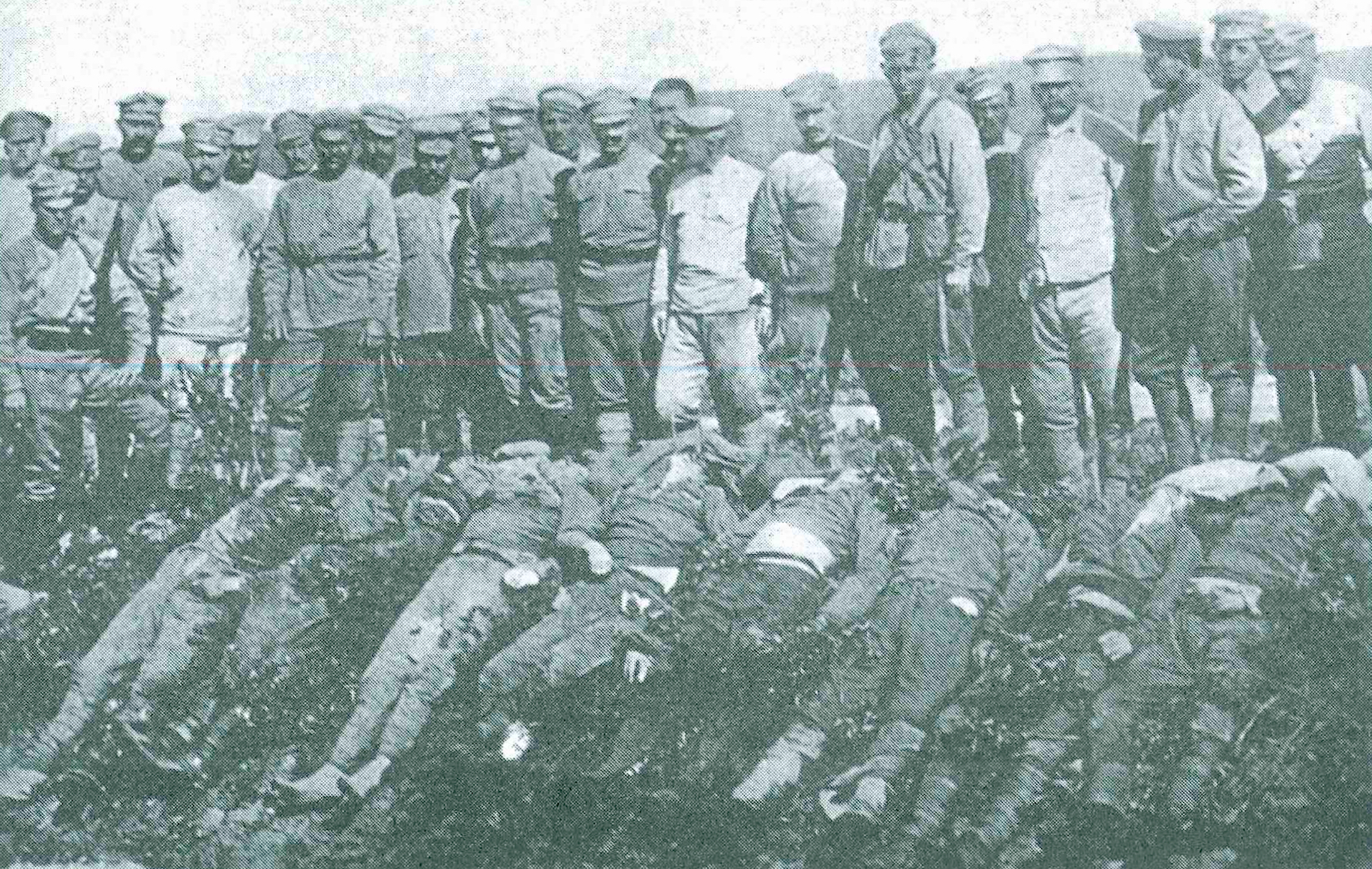
In Ussuriysk in the Siberian region of the Russian Far East shortly after leaving World War I, in July 1918, Czechoslovak Legion soldiers accumulated and surrounded the bodies of their comrades who had been killed by the Russian Red Army.

 In July 1918, Czechoslovak Legion soldiers were killed by the Russian Red Army in Ussuriysk, in the Russian Far East, shortly after the country's departure from World War I. The Czechoslovak Legion soldiers accumulated the corpses of their murdered comrades and surrounded them. By June, both sides were fighting along the Trans-Siberian Railway from Penza to Krasnoyarsk.

 By the end of June 1918, Vladivostok was overrun by the Czechoslovak Legion and declared an Allied protectorate. The city was made a landing point for Japanese, American, French, and British forces relieving the White Army, and by mid-July the Czechoslovak Legion, along with its White allies, had overrun all cities on the Trans-Siberian route from Samara to the Pacific Ocean. As Allied forces closed in on Yekaterinburg in the Urals, where the last Russian emperor, Nicholas II, was imprisoned, the Bolshevik Red Army promptly executed Nicholas II and his family by firing squad on July 17. They buried them in the woods along the Kopchaki Road, and on July 25 the Czechoslovak Legion overran Yekaterinburg.

 On August 5, 1914, the Czechoslovak Legion was organized within the Russian Imperial Army to fight against Austrian and allied forces to establish a state; in November 1917, the Bolsheviks seized power throughout Russia. The Czechoslovak Legion set out from the Ukraine along the Russian railroads to transports from the port of Vladivostok in the Far East. on March 3, 1918, the Treaty of Brest-Litovsk withdrew the Russian Imperial Army from the First World War.


 By the end of August 1918, the Czechoslovak Legion was in control of Vladivostok. In early July 1918, American, Japanese, and other forces deployed to Vladivostok, Siberia, to rescue Czechoslovak troops who had been held back by the Bolsheviks in Transbaikal. soldiers sought to return to their homeland.

 On November 14, 1919, the Red Army occupied Omsk, the capital of the White Army, and a desperate flight to the east by the White Army and refugees along the Trans-Siberian Railway began; on February 7, 1920, the Czechoslovak Legion signed a truce with the Red Army in Kuching; on March 1, 1920, the last Czechoslovak train, Irkutsk on the Trans-Siberian Railway and withdrew by sea from the port of Vladivostok to take refuge in their homeland. The total number of people evacuated with the Czechoslovak Legion in Russia was 67,739, and approximately 4,112 people were killed in Russia during World War I and the Russian Revolution.


Wednesday, August 30, 2023

During the Russo-Japanese War Battle of Liaoyang, Japanese troops searched and autopsied the bodies of Japanese soldiers killed on the battlefield near Liaoyang; on August 30 and 31, 1904, a renewed Japanese attack was repulsed by Russian forces, resulting in heavy losses.

During the Russo-Japanese War Battle of Liaoyang, Japanese troops searched and autopsied the bodies of Japanese soldiers killed on the battlefield near Liaoyang. From August 30, the corpses of Japanese soldiers were buried on the battlefield near Liaoyang.

 For the first time in the Russo-Japanese War, the battlefield of Liaoyang was the scene of a clash between two major armies, the Japanese with some 127,360 soldiers and the Russians with some 245,300 soldiers. The Battle of Liaoyang began with the Japanese invasion on August 26, 1904, and fighting broke out simultaneously on all fronts from August 30 in the city of Liaoyang. For about five days, the fierce offensive and defense were repeated. The Russian forces stationed in Liaoyang built a strong defensive position, and on August 28, the Shoushan Fort in front of Liaoyang became a disastrous battleground, with the main Russian forces defeating the Japanese forces. In the southern part of Liaoyang, the two armies engaged in a pitched battle, and the battlefield was extremely fierce. The Russian forces involved in the Battle of Liaoyang numbered approximately 224,600 with approximately 20,000 casualties, while the Japanese forces numbered 134,500 with approximately 23,533 casualties. Officially, the Japanese forces lost about 5,537 dead, the Russian forces lost about 3,611 dead, the Japanese forces suffered about 18,063 casualties, and the Russians suffered about 14,301 casualties. Later Soviet research put the total number of Japanese casualties at about 23,615, compared to Russian casualties of about 15,548.

 On August 31, Japanese troops crossed the Taizu River, which runs east to west just north of Liaoyang city, and the left flank of the Russian army was hit; on September 1, about half of the Japanese First Army crossed the Taizu River about 13 km east of the Russian front; on September 3, Kuropatkin, commander-in-chief of the Russian army, ordered his Russian troops to abandon Liaoyang and retreat to Mukden. Mukden. The Russians' defenses of Manchuria and their rebellion on the Liaoyang peninsula, with the exception of Fortress Arushun, were frustrated, and on September 4, the Japanese took control of the Liaoyang area. The Russian forces retreated to Mukden, and on September 8 the completion of the retreat of all troops was announced.

 The Russo-Japanese War attracted many foreign correspondents to the combat experience. From their safe positions, foreign correspondents were unable to witness the heroism, chivalry, devotion, sacrifice, patriotism, combat, and casualties of the Japanese soldiers. The Russo-Japanese War was thoroughly documented and reported as top news. General magazines such as Collier's and Harper's Weekly, as well as newspapers, relied heavily on visual information. In the process of visualizing and narrating the Russo-Japanese War, visual information was irreverent, eye-catching, and exaggerated. It reminded one of the Battle of Liaoyang and, in the United States, the Civil War. It heightened the threat that the Japanese military was poised to engage the United States in a potentially apocalyptic race war.


Tuesday, August 29, 2023

The Theresienstadt camp in Czechoslovakia had no food, and many inmates died of starvation or disease. The original population was about 6,000 in 1943, about 100,000 were incarcerated in the camp. About 300 people died each day from disease, starvation, and overwork.

 There was no food in the Theresienstadt camp, and many inmates died of starvation or disease. The Theresienstadt camp had an original population of about 6,000, and in 1943, about 100,000 people were interned. Every day, about 300 people died each day from disease, starvation, and overwork.

  In March 1939, the Germans invaded Prague, Czechoslovakia, and Czechoslovakia was dismantled. A concentration camp was established on November 24, 1941 in Terezin, about 60 km north of Prague, the capital of Czechoslovakia. Terezin utilized a fortress installed in the 18th century, surrounded by a deep moat and thick, high earthen walls, at the camp. About 400,000 Jews were interned at Terezin, and on January 20, 1942, the Winsee Conference announced a plan for the extermination of the Jews.

 In 1942, the Nazis expelled approximately 7,000 Czechs who lived in Terezin and isolated them in the closed environment of the Jewish settlement. The Nazis initially designated the Terezin camp as a camp for elderly, privileged, and famous Jews from Germany, Austria, the Czech Republic, and Western Europe; beginning in the fall of 1942, more than a dozen freight trains began forcing those unable to work forcibly from Terezin to the Auschwitz concentration camp, an extermination camp in the east. They were taken to Auschwitz, an extermination camp in the east. Terezin was used as a transit point to Auschwitz.

 Approximately 15,000 children passed through the Terezin camp where their education continued with a rigorous daily routine of classes, athletic activities, and art. They drew pictures and wrote poetry. By the end of the war, however, fewer than 150 to 1,100 children survived. 44-year-old female painter Friedl Dicker Prandis stood up for painting education by risking her life, which was forbidden. on October 6, 1944, painter Friedl also was forcibly taken to the East.

 On May 15, 1944, a delegation of the International Red Cross visited Terezin. The inmates were made to disguise their absolute submission through fear and execution; November 1944 was the last forced removal from Terezin to Auschwitz. The Germans transferred the camp to the International Red Cross on May 3, and Soviet troops liberated the Terezin concentration camp on May 10, 1945. About 4,000 paintings with the children's names were found in the trunk 10 years later. Of the approximately 144,000 Jews sent to Terezin camp, about 33,000 died at Terezin and about 88,000 were sent to Auschwitz and other extermination camps. Only 19,000 survived to the end of the war.


Monday, August 28, 2023

During the Battle of Iwo Jima in the Pacific War, the bodies of many slain Japanese soldiers lay in trenches on a volcanic ash beach on March 1, 1945. Wrecked equipment was scattered around the Japanese soldiers on the beach and in the sea.

  During the Battle of Iwo Jima in the Pacific War, the bodies of many slain Japanese soldiers lay in trenches on a volcanic ash beach on March 1, 1945. Wrecked equipment was scattered around the Japanese soldiers on the beach and in the sea. American forces landed on Iwo Jima and, from the bridgehead, assaulted and swept through the Japanese garrison. The Americans deployed armored bulldozers to clear passages for tanks, and also deployed flame-throwing Zippo tanks to break up the Japanese positions.

 The American forces, unable to receive tank support due to the complicated terrain, attacked the Japanese positions one by one with flamethrowers, explosives, and bazookas. The Japanese forces opened fire from hidden tochkas and underground positions. The Americans suffered 512 casualties on February 26 and 792 on February 27, the worst casualties since the Iwo Jima landings, but could do little. 382 Highland, one of the main positions, was captured on March 2 with heavy casualties of about 610. The battlefield around the 382nd Highland was called the Meat Grinder.

 The most formidable Japanese defenses on Iwo Jima were not on the beaches, the summit of Mount Suribachi, or the plains leading to the airfield. It was in the foothills and knolls, in the crevices and caves, in the shrubby forests and rocky cliffs, in the humble climate that formed the backbone of the Japanese garrison's defensive line. The Japanese built a maze of disguised, heavily reinforced positions in the hills and valleys around the southern part of Iwo Jima. They ranged from shooting depressions and sandbag-laden caves to massive positions with reinforced concrete walls about 1.2 meters thick. It was very tough to strategically invade and get through.

 Shattered tree stumps, sharp rocks, outcroppings, canyons, and other crater-like black ash beaches shared the horror, confusion, and terror, both physical and emotional. Thousands of soldiers from both sides lost their lives in this chaotic and indescribable battlefield hell of Iwo Jima. American forces finally declared Iwo Jima safe on March 26 after the final Japanese banzai attack on troops and airmen near the beach. American forces took control of the ground on Iwo Jima on April 4. During the four weeks of fighting over tiny Iwo Jima (February 19 to March 26), American soldiers suffered approximately 25,851 casualties, of which 5,931 died. About 17,845 Japanese soldiers were killed in action, and about 1,033 were taken prisoner of war.


Sunday, August 27, 2023

In Chernihiv, northern Ukraine, a local man covered a body that was killed after a Russian missile attack. The men then sat grieving by the covered corpse.

  In Chernihiv (Chernihiv), northern Ukraine, a local man covered a body that was killed after a Russian missile attack. The men then sat grieving by the covered corpse. Footage from the immediate aftermath showed badly damaged buildings, including a theater with its roof blown off, mangled cars, and survivors walking through the rubble in bloodied clothing. The square in front of the theater was alive with people returning from church with baskets of consecrated apples in their hands, celebrating the religious holiday of the Apple Festival of the Savior. Shards of the theater roof littered the square after the missile strike, as well as shattered windows of nearby cars and restaurants.

 Russian forces launched a missile attack on Chernihiv, the capital of Chernihiv Oblast in northern Ukraine, on August 19, 2023. It hit the central square in the center of Chernihiv, killing seven people, including a six-year-old girl, and wounding 144, 41 of whom were hospitalized, Ukrainian authorities said. Of the 144 injured, 15 were children. The dead girl's name was Sofia. Of the 144 injured, 15 were police officers. Most of the victims were in their cars. On August 19, a missile attack erupted as Ukrainian President Volodymyr Zelensky arrived in Sweden on a visit.

 Chernihiv, located about 145 km north of the capital Kiev, had lush boulevards and centuries-old churches. The attack on Chernihiv coincided with the Orthodox holiday of the Transfiguration of the Lord. The square in front of the damaged theater and surrounding buildings were littered with debris, and parked vehicles were severely damaged. The roof of the historic theater was ripped off by the missile attack. Shortly thereafter, survivors walked through the rubble in badly damaged buildings, including a theater with its roof blown off, mangled cars, and bloodied clothing. Ukrainian rescue workers worked at the site of the missile attack.

 The Russian invasion of Ukraine on February 24, 2022, triggered the siege of Chernihiv. Russian forces failed to capture the city and instead bypassed Chernihiv through an alternative route to the capital, Kiev; on March 6, 2022, the Ukrainian government granted Chernihiv the special title of Hero City. The Russian siege was released on March 31.


Warning: A man covered a dead body after a Russian attack, in Chernihiv, Ukraine, August 19,2023. A man sit beside a covered dead body after Russian attack. (National Police of Ukraine via AP)

Saturday, August 26, 2023

A 3-year-old boy exposed to the Nagasaki atomic bomb developed A-bomb sickness about a month later and was admitted to Ward 8 of the Omura Naval Hospital on September 7, 1945. On admission, his breathing sounds were coarse and his abdomen was distended. Blisters remained on both hands and feet.

    A 3-year-old boy exposed to the Nagasaki atomic bomb that exploded on August 9, 1945, developed A-bomb sickness about a month later and was admitted to Ward 8 of the Omura Naval Hospital on September 7. When he was admitted, his breathing sounded coarse and his abdomen was distended. Blisters remained on both hands and feet. After the blisters had healed, their crusts adhered to many of them. The scalp of the boy's head was alopecia and scarring formed after the blisters healed. The boy's admission record did not contain any injury or illness related to A-bomb disease, and his progress after admission was also unclear.

 The incubation period before the appearance of A-bomb sickness tended to correlate with the distance of the survivors from the hypocenter. Within about 750 m from the hypocenter, symptoms appeared from the day of the explosion. For those exposed at about 1 km from the hypocenter, A-bomb sickness appeared about 4 days later. For survivors exposed between about 1 km and 1.5 km from the hypocenter, A-bomb sickness appeared on about the 10th day. Those survivors who had no external injuries and no abnormalities immediately after the bombings subsequently developed fatigue, loss of appetite, and fever of up to 40°C. At the same time, many survivors developed neck and neck pain and fever of up to 40°C. At the same time, swollen and painful cervical lymph nodes, sore throat, and hoarseness appeared in many A-bomb survivors. Over the next few days, watery, mucousy, and bloody diarrhea appeared, followed by hematuria. The epilation started as a needle-head sized area in the beginning, and petechial hemorrhages eventually spread over the entire body, and at the same time bleeding from the mouth and gums and epistaxis began.

 Strange herpes-like rashes were observed around the mouths of many survivors. As death approached, it became gangrenous and was accompanied by a pronounced odor. There was no abnormality in cardiac function except for a drop in blood pressure in the final stages. Many survivors developed terminal pneumonia. Many A-bomb survivors complained of stomach pain, but there was no vomiting, although roundworms were observed. Central nervous system disorders, such as visual impairment, appeared in the terminal stages of the disease. The survivors were unable to recognize the number of fingers from approximately 30 cm away. The survivor who did not suffer from CNS disorder did not show any abnormality in his mental condition even in the final stage of the disease, when marked anemia and high fever appeared. Even though the trauma wounds showed a tendency to heal, the granulation eventually became gangrenous and swollen. The injection site became infected and necrosis occurred. (Omura Naval Hospital, Masao Shiotsuki, The Effect of theExplosion of the Atomic Bomb on the Human Body: Reported on September 10, 1945.)


Friday, August 25, 2023

On the night of January 30-31, 1945, as the Soviet Red Army approached from the Eastern Front of World War II, some 819 political prisoners from many European countries were executed at the Sonnenburg concentration camp on the Polish.

On the night of January 30-31, 1945, as the Soviet Red Army approached from the Eastern Front of World War II, some 819 political prisoners from many European countries were executed at the Sonnenburg (Sonnenburg) concentration camp. A group of SS detachments and Gestapo from Frankfurt, along the Oder River on the Polish border, carried out the massacre in the courtyard of the concentration camp. At about 10:00 p.m., the guards divided the prisoners into groups of ten and took them into the concentration camp courtyard. The Gestapo lined up about 800 or more prisoners against the wall and shot them to death. Survivors were killed with machine guns aimed at the back of the head. After the massacre, fire was set on some of the corpses, and when Soviet soldiers entered the Sonnenburg camp on February 2, their bodies were still lying in the courtyard. Among the corpses at the execution site, four survived.

 The Sonnenburg concentration camp, located in Suhons on the Polish border about 95 km east of Berlin, was officially closed on April 23, 1934, but was still used in practice; since the beginning of World War II in September 1939, concentration camps or punishment camps had been used as anti-German concentration camps and labor camps for anti-German citizens of the occupied territories until 1945. The concentration camps contained political prisoners, all of whom opposed the Nazi Third Reich, and at the time the Gestapo was ordered to withdraw the concentration camps on January 30, 1945, the Soviet Red Army was only 35 km from Sonnenburg. The concentration camp was ruled by torture, and the east basement and west wing of the camp were separated into cells called torture chambers. Prisoners were exhausted, demoralized, and terrified, and many chose to die and commit suicide.

 Sonnenburg (now Sunnsk) was the first concentration camp of the Nazi Third Reich, and on April 4, 1933, the first transfer of prisoners arrived at Sonnenburg; the political opponents of Adolf Hitler, who had just come to power in early 1933, were at the heart of the prisoners and immediately began a purge. Underground storage rooms in the capital Berlin were used as temporary prisons, but they were already overcrowded. Sonnenburg was located about 95 km from Berlin and was connected to Berlin by rail. Poor working conditions, poor nutrition, torture, and lack of medical care led to the spread of deadly epidemics among the prisoners. The prisoners in the concentration camps were all citizens who were averse to National Socialism: communists, social democrats, pacifists, Jews, Catholics, Protestants, workers, and political professionals.


Thursday, August 24, 2023

In the Vietnam War, the American soldiers carries a Viet Cong casualty past the body of a Viet Cong casualty on December 8, 1967. About 49 Vietcong were killed in action at the Battle of Bu Dop, and four American soldiers were killed in action.

  In the Vietnam War, soldiers of the 1st Brigade, 1st Infantry Division of the U.S. Army, carrying Viet Cong and other war wounded, pass by the bodies of Viet Cong (VC: South Vietnam Liberation Front) dead on December 8, 1967. About 49 Viet Cong were killed in action and four U.S. soldiers were killed in action in a fierce battle in the Bu Dop area at midnight the same day. The U.S. military's Bu Dop base, established in November 1963, was located in Bu Dop district, Binh Phuong province, near the Vietnam-Cambodia border.

 At about midnight on November 29, 1967, the Viet Cong attacked the fortified U.S. Bu Dop area, and at about 10 p.m. on November 29, Viet Cong mortars and rockets flew into the Bu Dop base. The rockets hit a bunker, killing all four American soldiers. Hundreds of Vietcong soldiers charged from the east side of the runway after the artillery fire ended, crossing about 200 meters from the woods and assaulting the Boo Dopp base. The U.S. troops fired howitzers at the Vietcong as they charged, taking out many of the Vietcong forces that were forcing their way through. U.S. F-100 fighter-bombers attacked the forests where the Vietcong were hiding with bombs and artillery. The Vietcong assault was frustrated and they quickly withdrew into the forest. U.S. casualties were about 7 dead and 11 wounded, and the Vietcong casualties were 31 dead bodies left behind.

  For the next week, U.S. forces continued to clash with Vietcong forces around Bou-Dop, with mortar shells landing nightly. In response to the second major Vietcong attack on the Boo Dopp base, U.S. forces reinforced the base at the Boo Dopp airstrip on December 4. Two days later, U.S. forces established a firing base southeast of Boo Dopp, which the Viet Cong invasion had targeted, and at about 1:00 a.m. on December 8, U.S. forces attacked Viet Cong positions, with the main assault force invading under rocket fire. Under very short engagement distances, U.S. artillery cut through the Vietcong forces with high-fire artillery shells, preventing them from reaching the outer lines of the base. American air strikes, armed helicopters, and mortars inflicted further losses on the Viet Cong. The Vietcong then withdrew from the Boo Top area at approximately 3:00 a.m. on December 8. The next day, December 9, the U.S. military conducted autopsies on about 49 Vietcong dead and four military dead. The Boo Top base was then transferred to the South Vietnamese Army on December 31, 1970.


Wednesday, August 23, 2023

Bodies of soldiers from both sides who died in a battle on October 18 near Liujiamiao Station on the outskirts of Hankou. The insurgents defeated the Qing army in that battle.

 On October 18, 1911, the Wuchang Uprising of the Xinhai Revolution killed soldiers from both the rebel and Qing forces in a battle near the Liujiajiao Station in the suburbs of Hankow. The corpses of the two armies were scattered near the Liujiaomiao Station in the suburbs of Hankou. The rebels defeated the Qing forces in the battle that day. The Qing forces retook the rebel city of Hankou on November 1 after the battle of Hankou on October 18, and the Beiyang forces retook the rebel city of Hanyang on November 27. The city of Wuchang was reduced to ruins with numerous casualties.

 On October 10, 1911, at about 8:00 p.m., the 8th Battalion of the Hubei New Army's 8th Township (Division) Engineers delivered the first blow to the Wuchang Uprising's Qing police force. The rebels then occupied the Zhuangdai Armory. After the outbreak of the Wuchang Uprising, the 8th Standard (Regiment) Battery, stationed at Nanhu on the outskirts of the city, entered the city through Wuchang's Zhonghe Gate (later renamed the Gate of Unrest) and entered the battle for the Governor's Palace. The rebels carried their artillery to the top of Wuzhou Mountain and bombarded the Huguang Governor-General's Office. Hunan and Guangdong Governor Ruolei fled by train from Dazhimen in Hankou, and the rebels then occupied Hunan and Guangdong Governor-General's Office. After occupying Wuchang, the rebels heavily guarded the gates of Hamyang and checked passersby.

  On the night of October 11, 1911, soldiers of the 2nd Battalion of the 42nd New Army in Hankou mutinied, seized the armory at Chumangdai, and overran Hankou; by noon on October 11, about 500 more Qing soldiers were killed; on October 11, the rebels captured the entire city of Wuchang. Later that day, the revolutionaries established the Hubei Military Government of the People's Republic of China in the Hubei Consultative Bureau of the former Qing government. The rebels set up the Ejundubu and installed their officer Li Yuanhong as governor-general, the representative of the military government, and on October 31, the People's Network News, the official newspaper of the military government in Hubei Province, proclaimed the success of the revolution in the name of Sun Yat-sen. Sun Yat-sen proved to be the leader of the revolutionary party at the time of the Wuchang Uprising.

 In response to the uprising, the Qing Dynasty sought help from the Beiyang Army's Yuan Shikai. The Beiyang Army invaded Wuchang, and on the side of the revolutionary forces, Huang Xing arrived in Wuhan in early November and took over command. The Beiyang Army then attacked the Revolutionary Army's positions, and the Qing forces retook Hankou on November 1 after the Battle of Hankou on October 18, and the Beiyang Army retook Hanyang on November 27. The ROC negotiated with Yuan Shikai and gave him the position of Grand President in return for his surrender of the Qing court; on December 29, 1911, the ROC elected Sun Yat-sen as President in an extraordinary presidential election; on February 12, 1912, Empress Dowager Long Yu announced the abdication of the Qing Emperor in the name of Emperor Puyi, thus ending the Qing Empire. About 8,000 Qing troops were killed, and about 4,000 revolutionary troops were killed.


Tuesday, August 22, 2023

During the Battle of Okinawa in the Pacific War, an American scout soldier who was in the valley of the Oroku Peninsula and was killed or wounded lies beside an American soldier who invaded the Oroku Peninsula, where the Japanese naval air station was located, on June 4, 1945.

     During the Battle of Okinawa in the Pacific War, U.S. forces landed from Oroku Beach southwest of Naha, Okinawa, on June 4, 1945, and invaded the Oroku Peninsula, where the Japanese Naval Air Station was located. Beside the U.S. scouts lay a U.S. soldier who had been killed or wounded in the valley of the Oroku Peninsula, and as of June 4, the Japanese naval forces were struggling to attack and defend almost half of the Oroku Peninsula.

 Japanese naval forces returned to their old positions at Oroku Naval Air Station from Maepyeong in the south on the night of May 28, 1945. American forces landed on Oroku Beach from an amphibious assault on June 4, increasing the speed of the invasion. They advanced to the Oroku Naval Air Station position defended by the Japanese naval forces. The IJN's fighting force was small and poorly equipped. The IJN took separate action from the Army garrison and confined itself to the Oroku area to fight the invasion, and by the retreat on May 26, it had destroyed its remaining heavy weapons and had only about 4,000 men. By June 5, the Japanese naval forces were surrounded by American troops and were unable to retreat. On June 6, Rear Admiral Minoru Ota sent a telegram to all parts of the country, saying, "The people of Okinawa are fighting this war, and I hope that the people of Okinawa will be granted special favor in future generations.

   The U.S. invasion of the Oroku Peninsula was met with fierce resistance from Japanese naval forces, which suffered heavy losses, and on June 11, the U.S. forces surrounded the positions of the Japanese naval forces. The siege of the Oroku Peninsula lasted for about 10 days, resulting in approximately 1,608 casualties among the U.S. forces. Despite the meager weaponry of the Japanese naval forces, the casualty rate of the American forces far exceeded that of the Shuri Offensive. The Japanese naval forces were annihilated and crushed by suicide when a group of American tanks attacked the cave headquarters on June 11. In the naval headquarters dugout, five of the staff officers committed suicide together on June 13. After overrunning the Oroku area, the U.S. forces conducted a special search of the cave command center in the bunker of the Japanese naval forces. The bodies of hundreds of Japanese soldiers who had committed suicide lay there. In the central room of the bunker, they found the corpses of five senior officers. The hill where the bunker of the headquarters of the Japanese naval forces was located was named "Admiral's Hill. In the Kosoku area, on June 12 and 13, for the first time in the Battle of Okinawa, about 159 Japanese soldiers surrendered en masse and were taken prisoner.


From April 29 to December 24, 1945, as Nazis—and nothing other than Nazis—Austrians were forced to exhume corpses.

The Soviet Union acted in its own self-interest. At times it took an extremely hard line against the Nazis, while at other times it behaved ...