Sunday, October 15, 2023

On September 6, 2023, in the Russo-Ukrainian War, Kostiantynivka in Donetsk Oblast came under Russian missile attack. Bodies of Ukrainian civilians lay dead in front of an outdoor market; 17 people were killed and 32 wounded.

   In the Russo-Ukrainian War on September 6, 2023, the Ukrainian city center of Kostiantynivka came under missile attack by Russian forces. After the shelling, the bodies of Ukrainian civilians lay in front of a burning marketplace. In Kostiantynivka, in eastern Ukraine, Russian shelling killed about 17 people and wounded at least 32 others. The New York Times later reported on September 18 that evidence strongly suggested that the devastating attack in Kostiantynivka was the result of a misfire by a Ukrainian air defense missile fired by a Buk launch system.

 The Russian missiles tore through an outdoor market in eastern Ukraine, killing about 17 people and wounding about 32 others. In the city of Kostiantynivka, near the front line in Ukraine's Donetsk Oblast, a missile strike turned an outdoor market into a charred ruin, littered with corpses. The outdoor market is a civilian settlement, with no military facilities, and an arbitrary and indiscriminate attack broke out.

 There was the wreckage of the Kostiantynivka market, near a car engulfed in flames, and charred corpses lay in the street with their clothes still on. Behind a stall selling fresh parsley, rescuers found the body of a woman in plain clothes, covered in blood. Paramedics gave first aid to a casualty and transported her to an ambulance at an outdoor market after Russian missile shelling received by the Ukrainian city center of Kostiantynivka. Firefighters extinguished the flames, paramedics applied tourniquets, and placed the casualties on stretchers and blankets in the emergency vehicle. Some bodies were covered with posters and tarps. There were bodies covered on the ground, paramedics extinguishing a fire at an outdoor market stall, and a charred car near an outdoor market. Emergency crews extinguished fires in about 30 papillions of outdoor market stalls.


Warning: A dead body lies on the ground in front of a burning market after a Russian shelling attack in the city center of Kostiantynivka, Ukraine, Wednesday, Sept. 6, 2023. More than a dozen people were killed and dozens more were wounded Wednesday when Russian shelling struck a market in the city in eastern Ukraine, officials said. (AP Photo/Evgeniy Maloletka)


Saturday, October 14, 2023

The area around the hypocenter where the atomic bomb exploded in Hiroshima on August 6, 1945, collapsed. All occupants of the bus, which was set ablaze by the hot air from the atomic bomb, were killed. Soldiers from the U.S. occupation forces surveyed the damage caused by the Hiroshima atomic bomb in September 1945.

     At the end of World War II, the area around the hypocenter where the atomic bomb dropped on Hiroshima by the U.S. military on August 6, 1945, collapsed. All occupants of the bus that caught fire due to the hot air from the atomic bomb were killed. The fire damage caused tremendous loss of life. Soldiers from the U.S. occupation forces surveyed the damage caused by the atomic bomb in Hiroshima in September 1945.

 Immediately after the bombing, the firefighting and rescue teams were stripped of personnel and equipment, making the worst of the damage. More than 90% of the citizens of Hiroshima who were within about 500 meters of the hypocenter were killed; it is estimated that about 140,000 people, most of them civilians, died as a result of the atomic bomb blast that was dropped and exploded on Hiroshima on August 6, 1945. About half of those who died in the bombing were killed instantly, many of them literally vaporized by the heat rays. The U.S. Atomic Bomb Survey team entered the city of Hiroshima in September 1945 to conduct research.

 In September 1945, after the atomic bombs were dropped and exploded in 1945, Bernard Hoffman became the first American civilian photographer to be at the sites of the bombings of Hiroshima and Nagasaki. His photographs offered a glimpse of the devastating destructive power of the atomic bombs, and were published in the first issue of Life magazine in 1936. It was a photograph of the scene of Hiroshima after the atomic bombing. Soldiers from the U.S. occupation forces surveyed the desolate, charred wreckage of a bus in which an atomic bomb had been dropped and its occupants had perished.


Friday, October 13, 2023

In November 1943, two sailors from the Liscomb Bay aircraft carrier, a ship that was sunk during the Battle of Marin in the Pacific War, were covered with American flags and buried in the Pacific Ocean waters from the Coast Guard ship Leonard Wood.

   In November 1943, shortly after the Battle of Marin in the Pacific War, two sailors from the ship USS Liscome Bay (CVE-56) were covered with American flags and buried at sea in the Pacific Ocean by a Coast Guard ship; two petty officers who died aboard USS Liscome Bay (CVE-56), USS Leonard Wood (APA-12) were buried at sea by the crew of the USS Leonard Wood (APA-12). Two of the rescued crewmen died and were buried at sea by a marine burial, where bodies were buried at sea from ships, boats, and aircraft. 

  At 5:10 a.m. on November 24, 1943, the escort carrier and flagship USS Liscum Bay was sunk in only 23 minutes by the Japanese submarine I-175, which arrived near Makin One torpedo fired by I-175 detonated the Liscum Bay's aircraft bomb stockpile. Liscum Bay was hit in the worst place for bomb storage, unprotected from torpedo hits and debris damage. The explosion collapsed half of the ship. No one survived behind the forward bulkhead in the rear of the engine room. By the time the flames had subsided, all the sailors in the latter part of the "Riscum Bay" had been killed in the explosion. A massive explosion engulfed the entire ship, which sank rapidly. The attack on Liscum Bay accounted for most of the American casualties in the Battle of Makin. Of the Liscum Bay's crew of approximately 916 men, about 644 (53 officers and 591 enlisted men) were killed. Approximately 272 were rescued.

  The Battle of Makin broke out on Butaritari Atoll in the Gilbert Islands between November 20 and November 23, 1943, during the Pacific War. It took the U.S. forces four days to fully occupy Makin, with considerably more naval casualties than ground troops. The Japanese lost about 395 men killed in action, while the Americans lost about 763. The loss ratio was excessive for the U.S. forces, and the latter half of the Pacific War was one of the few battles in which the U.S. casualties exceeded those of the Japanese, even during the U.S. offensive phase of the war.


Wednesday, October 11, 2023

In World War II, an Allied bombing raid on Hamburg engulfed the asphalt streets in flames and burned to death the citizens of Hamburg at midnight on July 27, 1943. About 9,000 tons of bombs killed about 40,000 civilians and reduced the main industrial port to ashes.

  In World War II, an Allied bombing raid on Hamburg resulted in the asphalt streets being engulfed in flames at midnight on July 27, 1943, burning to death a large number of Hamburg citizens. About 9,000 tons of bombs killed some 40,000 civilians and reduced the main industrial port to ashes. In all, about 13,000 men, 21,000 women, and more than 8,000 children were killed. The Battle of Hamburg, code-named Operation Gomorrah, was an eight-day, seven-night air raid that began on July 24, 1943. At the time, it was the most intense attack in the history of air warfare and was later dubbed "Germany's Hiroshima" by British officials. Operation Gomorrah, a regional carpet bombing campaign, was drawn up by Harris and Charwell after they persuaded Churchill. The bombing campaign also regarded all Germans and Italians as hateful enemies.

   Royal Air Force Marshal Sir Arthur Travers Harris, known as Bomber Harris, was known within the Royal Air Force as "Butcher" Harris. He was directly and deliberately responsible for the military deaths of hundreds of thousands of innocent women, children, and old people in Germany during World War II. He should have been tried for war crimes along with the defendants at Nuremberg. Viscount Cherwell (Professor Lindemann) was the chief architect of the carpet bombing campaign against German cities and civilians.

  The operation was carried out by the Royal Air Force Bomber Command (including RCAF squadrons) and the US Air Force Eighth Air Force. Shortly before midnight on July 27, nearly 800 bombers raided Hamburg. The unusually dry and warm weather, the concentration of the bombing in one area, and the limited fire-fighting capability of the blockbuster bombs used in the early stages of the raid resulted in the so-called "Feuersturm" (fire whirlwind). A huge fire with wind speeds of up to 240 km/h and temperatures of up to 800 °C (800 °F) destroyed approximately 21 km² of the city center. Asphalt roads were engulfed in flames, and most of the casualties of Operation Gomorrah occurred that night. Many of the victims were in shelters, and on the night of July 29, Hamburg was again bombed by approximately 700+ bombers. The final raid of Operation Gomorrah took place on August 3. Much of the city was destroyed without a trace, and the number of dead is unknown.

  Hamburg had been particularly pro-British prior to the bombing, and was the ground on which resistance to Hitler was formed. The Hamburg air raid extinguished all pro-British sentiment, and resistance to Hitler was also destroyed. The German people believed Goebbels' propaganda of "terror raids" and became more inclined to defend Germany against the attacks of the dreaded coalition forces. The air raids prolonged rather than shortened the war.

  In July 1943, Curtis LeMay, a U.S. Air Force officer in the European theater, led an air raid on Hamburg. He was appointed commander of the 3rd Air Division there in September 1943; he was transferred to the Pacific Theater in August 1944, where he was responsible for executing all air raid operations against all of Japan.


In the Battle of the Philippines in the Pacific War, Japanese troops massacred Filipino civilians in Tapel, Cagayan Province, Luzon, on July 1, 1945. At a small bridge leading to the village of Tapel, Japanese troops killed three Filipino civilians.

  Japanese troops massacred Filipino civilians in Tapel, Cagayan Province, Luzon, on July 1, 1945, during the Battle of the Philippines in the Pacific War. At a small bridge leading to the village of Tapel, Japanese troops killed three Filipino civilians. on November 23, 1945, the man in the photo, Pedro Serono, exhumed the bodies of eight Filipino civilians massacred by Japanese troops and displayed eight skulls he found after the massacre. The skulls were used as evidence in the Japanese war crimes trial after U.S. military officials identified the location of the massacre.

  Japanese war crimes in the Philippines began with the U.S.-led Manila trial of former General Yamashita Bongbun, which opened in October 1945, and continued until April 1947, after the independence of the Republic of the Philippines on July 4, 1946. Over a period of about 18 months, 97 trials were opened and 215 defendants were indicted. The results of the war crimes sentences were 92 death sentences, 39 life sentences, 66 fixed-term sentences, and 20 acquittals. The U.S.-led war crimes trial in Manila ended in April 1947, after the Philippines gained independence in April 1947.

 Immediately thereafter, beginning in July 1947, the Philippine authorities took over the trials of the remaining Class B and C war criminals. from 1947 to 1949, the Republic of the Philippines conducted 73 war trials against 155 Japanese Imperial Army and Navy officers who had committed war crimes during the Japanese occupation of the Philippines. As a result, by December 28, 1949, 138 people had been convicted and 79 sentenced to death. 73 trials were held primarily for war crimes committed by the raging Japanese military in the Philippines, ranging from murder, rape, and torture of civilians to inhumane treatment of prisoners of war. 155 of the Japanese military accused, Of the 155 Japanese military defendants, 149 were sentenced. Of the Japanese military defendants, 79 were sentenced to death, 31 to life in prison, 28 to varying terms, and 11 were acquitted; Lt. Col. Yasuo Omura (Yasuo Omura), accused of war crimes in Cagayan Province in July 1945, was convicted and sentenced to life in prison on September 12, 1949, He was pardoned by President Elpidio Quirino in a July 4, 1953 pardon.


Tuesday, October 10, 2023

Israeli police station stands by the bodies of militants outside the police station that was overrun by Hamas gunmen on Saturday, in Sderot, Israel, Sunday, Oct.8, 2023. Hamas militants stormed over the border fence Saturday, killing hundreds of Israelis in surrounding communities.

   On October 7, 2023, the Israeli police station in Sderot (Sderot) was overrun by Hamas militants from the Palestinian Gaza Strip. The next day, October 8, outside the police station, Israeli police stood by the body of a dead militant from the Palestinian Gaza Strip and performed an autopsy.On October 7, Hamas militants attacked Sderot near Gaza, exchanged gunfire with Israeli police and civilians in the streets, and took over the town's police station. At least 20 Israeli police were killed. Hamas militants stormed across the border fence on October 7, killing hundreds of Israelis in the surrounding communities.

 The Hamas surprise attack from the Gaza Strip that broke out on October 7, 2023, was Israel's worst death toll in decades. Approximately 1,000 Hamas fighters participated in the initial invasion. Hamas gunmen breached the border fence surrounding Gaza with explosives and crossed the coast on motorcycles, pickup trucks, paragliders, and speedboats. The large number of deaths, the large number of prisoners, and the slow response to the onslaught pointed to a serious intelligence failure and undermined long-held perceptions that Israel has been handing out surveillance of the small, densely populated Gaza Strip territory it has controlled for decades. at least about 700 people, including 44 Israeli soldiers. killed, media reports said. The Israeli government formally declared war on Hamas on October 8. Israel has conducted major military operations in Lebanon and Gaza over the past 40 years, but no formal declaration of war has been made.

 Since October 7, Hamas militants have forcibly taken dozens of Israelis, including women, children, and elderly people, to the Gaza coast. Relatives of captured and missing Israelis were televised wailing in the fog and pleading for assistance. Hamas and smaller Islamic Jihad groups claimed to have detained about 130 more in Israel and forced them into Gaza. Israeli security forces killed about 400 Hamas militants. The United Nations put the number of displaced Gaza residents at more than about 123,000.

 The Palestinian Gaza Strip, a small enclave with a population of about 2.3 million, has been blockaded by Israel and Egypt for about 16 years since the Hamas occupation. Israeli retaliation against Hamas has hit more than about 800 targets, including an airstrike that destroyed most of the town of Beit Hanoun, northeast of Gaza, the Israeli military said. The Palestinian Ministry of Health said on October 8 that some 413 Palestinians, including 78 children and 41 women, were killed and some 2,300 injured.


Warning: Israeli police station stands by the bodies of militants outside the police station that was overrun by Hamas gunmen on Saturday, in Sderot, Israel, Sunday, Oct.8, 2023. Hamas militants stormed over the border fence Saturday, killing hundreds of Israelis in surrounding communities. (AP Photo/Ohad Zwigenberg)

Monday, October 9, 2023

A Cambodian wife embraces the body of her husband, who was killed in 1975 in Cambodia during the Battle of Phnom Penh. Her Cambodian husband was killed by the leftist extremist Khmer Rouge.

   A Cambodian wife embraces the body of her husband who was killed in 1975 during the Battle of Phnom Penh in Cambodia. A young widow grieves in anguish as she holds the body of her husband killed in battle (@ Don McCullin). Her Cambodian husband was killed by the leftist extremist Khmer Rouge.

 The Cambodian Civil War ended with the fall of Phnom Penh on April 17, 1975, when the Khmer Rouge took over Phnom Penh, the capital of the Khmer Republic (now Cambodia). in early April 1975, Phnom Penh, the last remaining stronghold of the Khmer Republic, was surrounded by the Khmer Rouge. and was completely dependent on aerial resupply from Pochentong Airport. With the Khmer Rouge's overthrow imminent, the U.S. government evacuated U.S. citizens and allied Cambodians on April 12, 1975; by April 17, the last line of defense around Phnom Penh had been overrun, the Khmer Rouge had taken Phnom Penh, and the government of the Khmer Republic collapsed.

 Captured Khmer Republican troops were taken to the Olympic Stadium, where they were executed. Senior government and military officials were forced to write confessions before their execution. The Khmer Rouge ordered Phnom Penh residents to leave the city forcibly, and Phnom Penh was emptied and transferred to Thailand, except for expatriates who took refuge in the French embassy until April 30. Foreigners were forced into the French Embassy compound. After about two weeks the foreigners were trucked to the Thai border and expelled. With the foreigners gone, Cambodia lost its only outside witness to the politics of terror initiated by the Khmer Rouge in Democratic Kampuchea.

  The Khmer Rouge took control of Phnom Penh and forced the forced displacement of some 2 million Phnom Penh residents to rural areas in the provinces. They were held at gunpoint in their homes and schools and fired upon if they did not move immediately. Even in hospitals, patients were forced onto the streets. Families were torn apart and children lost their parents in the chaos. Roads leading from the capital Phnom Penh were jammed, and thousands of people died. Friends and relatives were forced to emigrate quickly, leaving their bodies behind and carrying what little belongings they had.


Sunday, October 8, 2023

A Ukrainian soldier of the K2 battalion stood over the body of a Russian soldier lying in a trench on the front line near the town of Siversk, Donetsk region on 28 January 2023.

   A Ukrainian soldier of the K2 Battalion stands over a dead Russian soldier lying in a trench on the front line near Siversk, Donetsk Oblast, during the Russo-Ukrainian War, January 28. The Battle of Siversk was a battle of the Russian army, which was fought in the front line near Siversk.

 The Battle of Siversk was part of the Battle of the Donbass, a broad offensive in eastern Ukraine that began on July 3, 2022, during the Russian invasion of Ukraine. Russian forces ceased their attack on Siversk and its surroundings on July 28; throughout August there was a lull in the fighting, and with the Kharkov counterattack, Russian forces withdrew from positions around Siversk after September 8.

    Since July 2022, Russian private military companies, consisting primarily of Wagner units, have been attacking Bakhmut, an important transportation hub in the Donbass. Wagner has sent some 50,000 fighters, including some 40,000 prisoners. The U.S. Treasury Department designated Wagner, a Russian private military company operating in Ukraine, an international criminal organization on January 26, 2023.

 Ukrainian military fortifications prevented the Russian invasion of Kramatorsk, Sloviansk, Toretsk, and Siversk. The front line was located a few kilometers from Siversk. Like other residential areas in this direction, Siversk was bombarded by Russian troops.

      On January 27, 2023, the town of Chasov Yar in the Bakhmut district of Donetsk Oblast was also hit by shelling; two people were killed and five more wounded. Cars as well as residential and administrative buildings were damaged. on January 28, the Russian military launched a missile attack on the city of Konstantinovka, Donetsk Oblast. A residential area caught fire and four high-rise buildings, a garage, a hotel, and a civilian vehicle were damaged. At least three people were killed and two injured. After the shelling of Konstantinovka, Ukrainian authorities called on NATO to supply long-range missiles to the capital, Kiev.

 Conversely, on January 28, 2023, the Russian Defense Ministry announced that 14 people were killed and 24 wounded in an attack on a hospital in the village of Novoaidar in the annexed Lugansk region. Military personnel and local residents were being treated at the hospital facility. The hospital came under fire from a HIMARS missile system. Ukrainian authorities did not comment on the Russian Defense Ministry's statement. TASS news agency published photos of the destroyed hospital.


Warning: A Ukrainian soldier of the K2 battalion stood over the body of a Russian soldier lying in a trench on the front line near the town of Siversk, Donetsk region on 28 January 2023.(Photo by AFP/Anatoly Stepanov)

Saturday, October 7, 2023

The August 9, 1945 explosion of the Nagasaki atomic bomb derailed a streetcar that was destroyed by the blast and burned in early September 1945 near Urakami Station, about 1.5 km south of the hypocenter.

The August 9, 1945 explosion of the Nagasaki atomic bomb derailed a streetcar that was destroyed by the blast and burned in early September 1945 near Urakami Station, about 1.5 km south of the hypocenter. Approximately 16 of the approximately 63 biaxial cars of the tramcar were destroyed by the Nagasaki atomic bomb.

 The bombed area, centered on Urakami in Nagasaki, was a burnt-out area. In addition to the wreckage of the streetcars, there was also the overturned and burned wreckage of automobiles. Both sides of the railroad tracks were covered with debris. The bombed area in Nagasaki City was a long, narrow basin from north to south, surrounded on the east and west by mountains. Urakami Station was located approximately 1 km from the hypocenter. The station building was completely destroyed and many bodies were scattered around the premises. The casualties among JNR employees were also enormous: 65 of the approximately 70 employees on duty were killed, including 20 who died instantly.

 Nagasaki Electric Railway Company (Nagasaki Dentetsu) suffered severe damage to its main facilities, buildings, vehicles, and employees, with an approximately 3 km section between Nagasaki Station and Ohashi destroyed. The entire line in the former city was also shut down for several months. About 21 cars were destroyed by fire, 120 utility poles were toppled and broken, several power lines and tracks were destroyed by fire, and more than 100 employees were killed. The company was forced to suspend operations due to the inability to operate trains. Of the 56 cars owned by the company, about half were movable cars, and the deaths of employees (including mobilized students and female volunteers) accounted for 23% of the total of about 500 employees. On November 24, three months after the Nagasaki atomic bomb was dropped on August 9, 1945, streetcars again began running through the streets of Nagasaki. 


Friday, October 6, 2023

In the Russian Civil War following the Russian Revolution, a White Army execution squad shot two Bolshevik suspects and hanged two more in 1920. Outside Petrograd, the White Army's Okhrana Field Division executed a captured Soviet suspect.

  In the Russian Civil War following the Russian Revolution, a White Army execution squad shot two Bolshevik suspects and hanged two more in 1920. Outside Petrograd, the White Army's Okhrana Field Division executed a captured Soviet suspect.

 In areas where violence became commonplace and Bolshevikized peasants and workers took control, landowners and employers were robbed, tortured, and murdered. In areas where the White Army held the upper hand, police and soldiers found Bolshevik suspects and where they suspected them, they slaughtered them in cold blood. White Army execution squads shot and killed two Bolshevik suspects and hanged another two. The Russian Revolution, which began as a bloodless overthrow of tsarism, now claimed millions of civilian victims. There was hardly a region of vast Russia where the populace was not separated into Reds and Whites.

 During the years that Russia was torn by civil war, atrocities and violence by both the Red and White armies reached their zenith. Both the Reds and Whites terrorized everywhere, shooting and hanging large numbers of civilians. If the bourgeoisie does not want to exterminate us, now is the time to exterminate the bourgeoisie" (August 31, 1918), wrote the Pravda newspaper. The Pravda newspaper stated, "The rotten bourgeoisie must be wiped out mercilessly from our city. All these people must be registered, and those among them who pose a threat to the revolutionary class must be eliminated. Henceforth the anthem of the working class will be a song of hatred and revenge!" (p. 3). Under these circumstances, the losers had no choice but to surrender or flee, hoping for the mercy of the merciless victors.

 The Russian Civil War was fought primarily between the Red Army (on the side of the Communists and October Revolution) and the White Army (on the side of the Russian Right, Republicans, Monarchists, Conservatives, and Liberals).The two major combatants were the Red Army of the Bolshevik-led socialist state led by Vladimir Lenin and the White Army, which was an ally of the Russian military, the Bolsheviks opposed their domination.


Thursday, October 5, 2023

Australian anti-tank guns succeed in temporarily checking the Japanese advance down the Malayan peninsula in January 1942. Tanks halted by felled trees have been reduced to smouldering wrecks. A dead Japanese soldier lies in the foreground.

    Shortly after the outbreak of the Pacific War in World War II, on January 18, 1942 in the Greater East Asia War, Austrian anti-tank guns temporarily halted the advance of Japanese forces southward across the Malay Peninsula. Nine Japanese tanks were badly damaged by Australian anti-tank guns in front of Bakri. Near Bakri in the Muar area, Japanese tanks, blocked by fallen trees, were reduced to burning wreckage. In front of it lay the bodies of two Japanese soldiers killed by an Austrian anti-tank gun.

 After the Japanese attack on Pearl Harbor on December 8, 1941, Japanese forces moved southward through Malaya, culminating in the occupation of Singapore in February 1941, and the Australian 8th Division, which was assigned to Malaya at the end of 1941, was already tragically lost, with most of its men taken prisoner by the Japanese. Singapore had been a cornerstone of Australia's security during the Greater East Asia War, but that cornerstone was shattered with the fall of Singapore to the Japanese.

 The Battle of Muar, the last major battle of the Malay campaign during World War II, took place from January 14-22, 1942, on the Muar River and around the Gemensah Bridge. Allied soldiers inflicted heavy casualties on the Japanese in an ambush at the Gemensa Bridge and in a second battle that took place several kilometers north of the town of Gemas. The Austrian 8th Division killed about 600 members of the Japanese 5th Division in the ambush at the bridge. In the battle north of Gemas, Austrian anti-tank guns destroyed several Japanese tanks. In this battle, the Japanese suffered the heaviest losses of the Malay campaign.

 The ambush attack was a success for the Allied forces, but the defense of Muar and Bakri on the west coast was a complete failure. The 45th Indian Infantry Brigade was almost completely wiped out, and two Australian infantry battalions suffered heavy casualties. Allied casualties reached about 3,100, while the Japanese lost about 700 killed in action and 800 wounded. In the Malaya campaign and the Battle of Singapore, more than 1,800 Australian soldiers were killed in action and about 1,400 were wounded. Approximately 15,000 Australian soldiers were taken prisoner of war at the fall of Singapore.


Wednesday, October 4, 2023

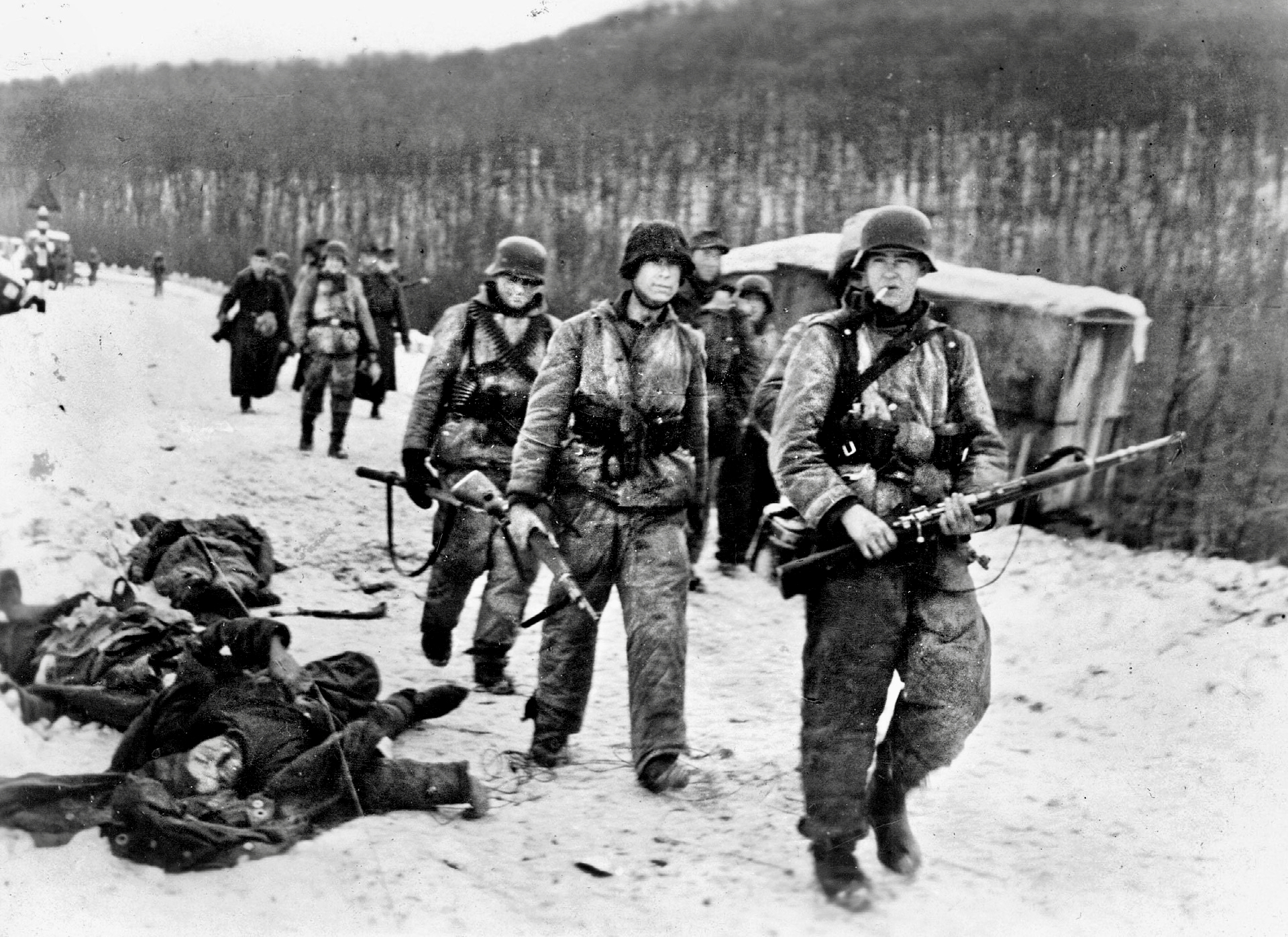
German armed SS soldiers invade the Hungarian capital of Budapest in a siege operation on January 23, 1945, with the body of a slain Soviet soldier lying on the edge of a snow-covered road on the way.

  Starting on January 18, 1945, German and Hungarian troops began the siege of Konrad III (Operation Konrad III), the lifting of the Soviet blockade of the Hungarian capital Budapest, until January 27. German Armed SS (Waffen-SS) soldiers invade the Hungarian capital Budapest in Operation Siege on January 23, 1945, as the bodies of slain Soviet soldiers lie on the edge of a snow-covered road on the way.

 On January 18, the first day of the offensive, the 4th SS Panzer Corps broke through the defensive positions of the Soviet 4th Guards and invaded deep into the defensive positions; on January 19, it broke through the continuity of the Soviet defensive line by sweeping through retreating Soviet troops and reached the Danube River near the village of Dunapentere; on January 20, the reserve force of Soviet forces, which were few in number, created a threatening situation on the 3rd Ukrainian Front.

 On January 21, the 5th SS Panzer Division defeated the Soviet 18th Panzer Corps and continued its northward advance. The Germans reached the floodplain of the Vary River 28 km southwest of the outskirts of Budapest, and after a long and bloody urban battle on January 22, the German 1st Panzer Division completely occupied Sturweisenburg. Soviet troops counterattacked the German 5th SS Division and 3rd SS Division. Between the villages of Adun and Ivancha, the 5th SS Division hit a large minefield. A German reinforcement reconnaissance battalion reached the Vary River, but the 5th SS Division was unable to approach the river due to heavy artillery fire by the Soviet artillery.

 On January 23, the 5th SS Viking-Panzer Division came under fire from Soviet anti-tank guns stationed on high ground on the northeast bank of the Valli River. They pursued the retreating Soviet units, which were repulsed in an attack near St. Peter's. They broke through both sides of the narrow-gauge railroad line and reached the other side of the Valais River. The 3rd SS Division was caught in the fighting of the onslaught by the Soviets.

 On January 24, the 5th SS Panzer Division and the 3rd SS Panzer Division launched a massive tank attack on Soviet positions behind the Valais. A 20-km wide section of the front broke through Soviet defenses; on January 26, the 4th SS Panzer Corps approached the Budapest cauldron at a distance of 25 km. The German tank groups that had advanced as far as the Danube River were cut off from their supply lines by the Soviet divisions, making them extremely vulnerable.

 On January 26, the Soviet 104th Rifle Corps and 23rd Tank Corps crossed the Danube River from the east bank and attacked the German groups from the north; on January 27, the German groups between Balaton and the Danube River had approximately 250 battle-ready tanks and assault guns remaining. A major Soviet counteroffensive began with a concentration of about 500 Soviet tanks and SAUs. In the south, in the sector of the front between Chalviz and the Danube River, the Soviets launched an offensive on the positions of the German 3rd Panzer Division. In the north, the Soviet 23rd Panzer Corps launched an assault on the Vali River with more than 100 tanks. The 5th SS Tank Division blocked the advance of the Soviet tanks for some time, and the Soviet troops also suffered heavy losses.

 On the night of January 28, 1945, orders were given to give up Operation Konrad III and prepare for an offensive at Dunafeldvar in southern Hungary; on January 28, the 4th SS Panzer Corps began a withdrawal to its original positions, retreating to the Bakonian Forest north of Lake Balaton, which it captured in Operation Konrad III All territory except Sturweissenburg was abandoned.

 Operation Konrad all but failed, and in the month-long fierce fighting in January, the 5th SS Panzer Division and the 3rd SS Panzer Division lost nearly 8,000 men, including more than 200 officers. The fighting in Budapest ended on February 13, 1945, with the surrender of the German-Hungarian Allied remnants.


Tuesday, October 3, 2023

After the fierce battle near Jiangqiao on November 18, 1931, the Japanese forces suffered casualties due to the massive bombardment of the Chinese troops. Japanese soldiers posted the war casualties on stretchers and transported them to their rear positions.

   On September 18, 1931, the Kwantung Army blew up the tracks of the South Manchuria Railway at Liujiaohu, a suburb of Mukden (now Shenyang) in the Republic of China, leading to the occupation of all of Manchuria (northeastern China) by the Kwantung Army on February 18, 1932. casualties. Japanese soldiers carried the casualties on stretchers to their rear positions.

  Beginning on the morning of November 18, 1931, the Japanese launched a general attack against the Chinese troops on the Sanmangbong. The Japanese bombarded the front line of the position for one hour, and the Chinese responded with artillery. At 8:00 a.m., the Japanese forces broke through the center, encircled the area, and launched a general attack. 10:00 a.m., the Chinese forces were unable to hold their position and retreated to the area of Ankang Creek. The Japanese added about 12 fighter planes, 12 tanks, and more than 30 pieces of artillery, and destroyed all trenches with heavy bombardment. The Chinese troops continued to fight and kill each other for a whole day and night, hungry, without rice or water, and shouting, until all brigades, half of them killed or wounded, retreated to Ankang Creek. The Chinese troops fought for three days, suffering more than 3,000 casualties, with about 2,000 more killed.

  During the Battle of the Three Watchtowers, the Chinese army requested reinforcements from all sides. None were directed from Beijing. Since the battle of Daoan Road, all the bullets were old stock from Heilongjiang Province, wet with mold and unusable. In one day and night of intense fighting, the Chinese soldiers had used up nine-tenths of their ammunition and could not fight a war unarmed. With many casualties, exhausted of ammunition and food, and no hope of survival, Ma Yushan ordered the Chinese troops to retreat. The Japanese army followed the Chinese troops from Hongqingzi. Ma ordered the provincial capital to be moved to Keshan and held Lunsha with about 500 guards and 700 cavalrymen.

  On the morning of November 19, the main Japanese forces occupied Yushu-tun, about 24 km from the provincial capital, and bombarded it with heavy artillery fire. About 5,000 or more Japanese soldiers invaded and occupied Qiqihar. Ma Chuangshan withdrew his troops from the Qiqi Road to Keshan, Baquan, and Hailun, thus ending the Battle of Jiangqiao. The Japanese forces suffered approximately 31 casualties, 104 battle casualties, 13 missing in action, and 300 frostbite victims during the Battle of Jiangqiao from November 4 to November 19. Chinese military losses were unspecified, but were estimated to be between 1,000 and 3,000. Ma Chuangshan arrived at Hailun on the evening of November 21. It was divided into positions at Wangyu, Hailun, Keshan, and Nulhe.


Monday, October 2, 2023

To incinerate the corpses of Ukrainians starved to death by starvation caused by the Holodomor, every evening around 1932, carriers dragged carts full of corpses to the mass graves.

  Every evening around 1932 carriers dragged carts full of corpses to mass graves for incineration of corpses of Ukrainians starved to death by starvation caused by the Holodomor. Ukraine was the site of the Soviet Holodomor (Ukrainian: голодомор), a famine-induced massacre that broke out in the territory of the Ukrainian Socialist Soviet Republic in 1932-1933, when the Soviets killed thousands of Ukrainians in the Holodomor (Ukrainian: голодомор). It was one of the worst national massacres in the modern history of Ukraine. The death toll ranged from about 2.5 to 7.5 million people. Joseph Stalin deliberately starved Soviet Ukraine. It marked the beginning of an era of genocide in Europe, with the Soviet army's ruthless requisitioning and looting of all the wheat.

  The Soviet Bolsheviks took control of Ukraine in 1919. In the years that followed, power passed from Lenin to Stalin's dictatorship. Even more than in Soviet Russia, where communal cultivation was traditional, peasants in Soviet Ukraine lost their farmland. From 1918 to 1921, just after the Bolshevik Revolution, the Soviet Bolsheviks requisitioned food from the peasantry while fighting a civil war. The Soviets were alarmed by the deportation of Ukrainian peasants to concentration camps after the mid-1920s.

  The Ukrainian peasants had few guns and poor organization. The Soviet state had a near monopoly on firepower and logistics. The Ukrainian peasants were monitored by the powerful Organization of State Police Units (OGPU), which recorded nearly one million acts of Ukrainian resistance in 1930. of the massive peasant uprisings that broke out in the Soviet Union in March 1930, nearly half occurred in Soviet Ukraine. in the first four months of 1930, about 113,637 self-employed farmers kulaks (Kulak) were deported from Soviet Ukraine. The huts of some 30,000 Ukrainian farmers were emptied one after another. Thousands of freezing wagons full of terrified, disease-ridden Ukrainians were deported to Northern Europe-Russia, the Urals, Siberia, and Kazakhstan. Ukrainian peasants were plunged into gunfire and cries of terror, frostbite and humiliation on the trains, and the agony and resignation of the slave laborers.

 In 1931, more than half of the harvest was taken out of Soviet Ukraine. Many collective farms were turned over seed grain to meet requisitioning goals. Stalin ordered the collective farms to hand over their seed grain on December 5, 1931. Many Ukrainian peasants really lost everything; by the end of 1931 many were already starving. The starvation was the result of sabotage, and local Communist Party activists became saboteurs and traitorous party officials; in the closing weeks of 1932, Stalin starved to death millions of Ukrainians in Soviet Ukraine. Ukrainians faced starvation, families were divided, parents against their children and children against each other. Families killed the weakest, their children, and used their flesh for food. Parents killed and ate their children, who later starved to death. One mother cooked her son for herself and her daughter, the National Police Organization (OGPU) documented.


Sunday, October 1, 2023

On the Russia-Ukraine War, the corpse of a Russian next to a position of the 35th Ukrainian Marine Brigade, on the southern front in Donetsk, July 2023..

  The corpses of Russian soldiers, abandoned in July 2023, litter the side of a position of the 35th Ukrainian Marine Brigade of the Ukrainian Army on the southern front of Donetsk Oblast, eastern Ukraine, during the Russo-Ukrainian War. When Ukrainian troops liberated Staromaiorske (Staromaiorske) on July 30, 2023, Ukrainian soldiers fought beside the corpses of Russian soldiers for a month. Ukrainian troops recaptured the town of Staromaiorske on the southern front of Donetsk Oblast on July 30, 2023. Not more than about 10 meters from the Ukrainian positions, the corpses of Russian soldiers lay abandoned for a month. invading in early June, the Ukrainian soldiers continued to fire. Ukrainian troops were at the entrance to Zaporizhia Oblast in the southern part of Donetsk Oblast. Finally, on July 30, they liberated Staromaiorske, a town on the vast plain.

 The smell of decomposition from the corpses of Russian soldiers is most unpleasant in less than a minute after an explosion. The bodies of dead Russian soldiers lay on the ground next to their helmets, dressed in their uniforms and bulletproof vests, flies buzzing around them. The Russians were ultimately unable to defend the occupied town of Staromaiorske. Maxim, the 25-year-old head of the Ukrainian army's mortar unit, said, "It is not our business to dispose of the bodies of Russian soldiers. We were not ordered by our commanders to dispose of the bodies." He stated. The Russian troops dug trenches in the Ukrainian tree line as a fortification as well, with dozens of mortar shells a few meters away.

  Ukrainian forces continued to clash with Russian troops in vast numbers. The Russians built defensive nets and trenches and defended themselves with fighter jets, drones, anti-personnel and anti-tank mines. Even after the occupation of Staromaiorske and the collapse of the Russian army, the Ukrainian government would not disclose the number of war dead, wounded or missing in action of the Ukrainian army. On the flat plain ground, with no wall backing or building defenses, between the pits left by logs, ditches, trenches, and holes protecting Ukrainian soldiers, 22-year-old Andrei flaunted his luxury apartment and self-deprecating holes that barely fit his body. When the Russians rained bombs and cluster munitions, he used the holes to protect himself during the attack, and when shells were close by, he got down on the ground just in case.


Warning: The corpse of a Russian next to a position of the 35th Ukrainian Marine Brigade, on the southern front in Donetsk.(LUIS DE VEGA/EL PAÍS)

From April 29 to December 24, 1945, as Nazis—and nothing other than Nazis—Austrians were forced to exhume corpses.

The Soviet Union acted in its own self-interest. At times it took an extremely hard line against the Nazis, while at other times it behaved ...